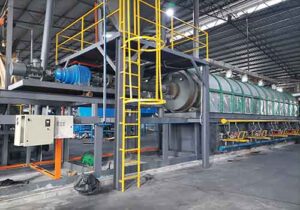

The core difference between the two technologies lies in how they manipulate process conditions to favor the formation of either a solid or a liquid product.
Carbonization (Slow Pyrolysis)
A carbonization machine is intended to carry out a process called slow pyrolysis. Slow pyrolysis is a process in which the main aim is to convert organic matter into a solid carbon material referred to as biochar or charcoal. This is carried out through a slow cooking process in which organic matter is heated over a long period of time, which can be days or even hours. This “slow cooking” process involves the removal of volatiles through a process that allows the carbon structure to change and produce a solid material called biochar. This process is carried out in a low oxygen environment to avoid the combustion of the biochar produced, which would reduce the biochar yield.
Fast Pyrolysis
On the other hand, a pyrolysis machine designed for fast pyrolysis is intended to produce the maximum amount of bio-oil possible. This is achieved by giving the biomass a “thermal shock,” which means that the biomass is rapidly heated to very high temperatures, often above 1000°C per second, but in a “oxygen-free” environment, also known as anaerobic conditions. The biomass is rapidly heated to temperatures of around 500°C for a very short period of time, which is less than two seconds, to crack the structure of the biomass into vapors and aerosols. The vapors are then rapidly cooled or “quenched” to condense them into bio-oil before they have time to react to produce more charcoal or non-condensable gases. The absence of oxygen is important to avoid combustion, which would produce CO2 and H2O instead of bio-oil.
The chemical and physical properties of the feedstock are critical and are chosen based on the desired primary product.
Ideal Feedstocks for Carbonization (Maximizing Biochar)
To maximize the output of high-quality biochar, the ideal feedstocks are those that are more resistant to thermal breakdown.
- High Lignin Content:Lignin is more thermally stable than other biomass components and tends to produce a higher yield of solid biochar. Therefore, woody biomass like logs is an ideal feedstock.
- Low Moisture Content:High moisture requires significant energy to evaporate, so drier biomass improves process efficiency.
- Low Ash Content:Ash is the non-combustible inorganic portion of biomass. A high ash content can reduce the quality and carbon percentage of the final biochar.
Ideal Feedstocks for Fast Pyrolysis (Maximizing Bio-oil)
Fast pyrolysis machines require specific feedstock properties to ensure the rapid heat transfer necessary for high liquid yields.
- High Cellulose and Hemicellulose Content:These polymers are desirable because they readily break down into the volatile compounds, such as anhydrosugars and furans, that form the bulk of bio-oil.
- Low Lignin Content:While lignin contributes phenolic compounds to the oil, a high lignin content is strongly associated with higher char yields, thus reducing the overall liquid output.
- Low Ash Content:A low ash content, ideally below 5%, is crucial. Minerals in the ash, like potassium and sodium, act as catalysts that promote the formation of gas and char at the expense of bio-oil.
- Small Particle Size:Feedstock must be finely ground, typically to particles less than 2-3 mm in diameter, to ensure near-instantaneous heat penetration. Large particles develop internal temperature gradients, leading to slower, char-forming reactions in the core.
The differing process conditions lead to dramatically different primary products.
Biochar: The Solid Gold from Carbonization
Biochar is a porous, stable, carbon-rich solid . Its primary applications include:
- Soil Amendment:Improves soil structure, water retention, and nutrient availability .
- Carbon Sequestration:Locks carbon in the soil for centuries, mitigating climate change.
- Solid Fuel:A clean-burning, high-energy solid fuel often used for cooking or industrial heat.
- Activated Carbon Precursor:It can be upgraded into high-performance activated carbon for industrial filtration .
In a modern carbonization machine, the typical yield of biochar is 35-40% by weight.
Bio-oil: The Liquid Fuel from Fast Pyrolysis
Bio-oil is a dense, dark liquid, but it is not a simple drop-in replacement for petroleum fuels due to several challenging properties.
- High Oxygen and Water Content:It contains 35-40% oxygen and 15-30% water, which gives it a low heating value (about half that of petroleum) and makes it immiscible with hydrocarbon fuel.
- High Acidity and Corrosivity:The presence of organic acids gives it a pH of 2-3, making it highly corrosive to standard materials like carbon steel.
- Chemical Instability:It is a complex mixture of hundreds of organic compounds that can polymerize over time, causing the oil to thicken, increase in viscosity, and even solidify.
In a fast pyrolysis machine, the typical yield of bio-oil is 50-75% by weight, making it the dominant product. However, its challenging properties mean it often requires significant and costly upgrading—such as distillation—before it can be used as a transportation fuel.
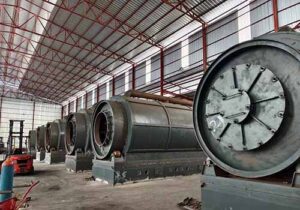
The design of carbonization and pyrolysis machines is tailored to their specific process requirements.
Carbonization Machines: From Earth Pits to Modern Kilns
Modern carbonization machines are the culmination of centuries of evolution from traditional charcoal-making methods.
- Traditional Methods:For millennia, charcoal was made in simple earth mound or pit kilns. Wood was stacked, covered with soil to limit oxygen, and partially burned over several days. These methods were inefficient, with low yields (8-15%) and high pollution.
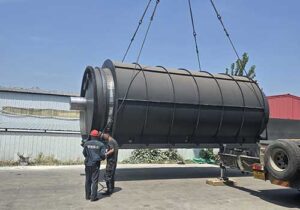
- Modern Industrial Machines:Modern machines like retort kilns and continuous rotary kilns are highly engineered to maximize biochar yield and quality. They use sealed vessels and external heating to precisely control the anoxic atmosphere. A prime example is the continuous rotary kiln, a large, cylindrical vessel inclined at a slight angle. To achieve the long residence time needed for carbonization, its mechanical features are carefully controlled:
- Low Inclination Angle:A gentle slope (e.g., around 7 degrees) slows the material’s travel through the kiln, increasing residence time.
- Slow Rotation Speed:Slower rotation further decreases the material’s transport speed, ensuring it is heated long enough for complete carbonization.
- Internal Lifters:These fins fixed to the interior wall lift and shower the biomass through the hot zone as the kiln rotates. This enhances heat transfer uniformity and also impedes the material’s flow, further increasing residence time.
Pyrolysis Machines: Engineered for Speed
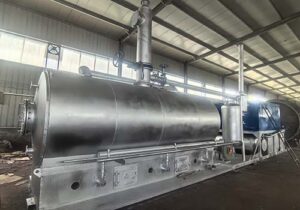
These reactors are engineered for the extremely rapid and efficient heat transfer needed for fast pyrolysis. The fluidized bed reactor (FBR) is a leading technology.
- Design:An FBR is a vertical vessel containing a bed of inert material, typically sand. A hot, inert gas is forced upward through the bottom, causing the sand to suspend and behave like a vigorously boiling liquid, which acts as a massive thermal reservoir.
- Rapid Heat Transfer:Finely ground biomass is injected into this hot, turbulent bed of sand and is immediately engulfed, facilitating near-instantaneous heat transfer and rapid decomposition.
- Short Vapor Residence Time:The high upward flow of gas swiftly sweeps the pyrolysis vapors out of the reactor in less than two seconds. This prevents the vapors from breaking down into less valuable gases and char.
- Vapor Separation and Quenching:Before cooling, the hot vapor stream passes through cyclones that use centrifugal force to separate out solid char particles. Immediately after, the char-free vapors are directed to a condensation system where they are rapidly “quenched” into liquid bio-oil.
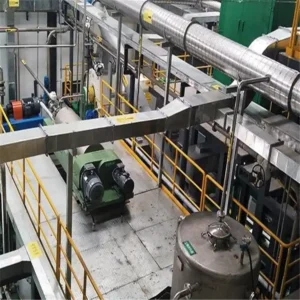
Both carbonization and fast pyrolysis yield a non-condensable gas called syngas (synthesis gas). Syngas is a mixture of hydrogen (H₂), carbon monoxide (CO), carbon dioxide, and methane. While in traditional kilns, this gas was emitted as smoke, in modern kilns, it is a by-product that has many uses other than heating.
- Electricity Generation:Syngas can be used as a fuel in gas engines or turbines to generate renewable electricity.
- Synthesis of Liquid Fuels:Through the Fischer-Tropsch (F-T) process, syngas is catalytically converted into liquid hydrocarbons, including synthetic diesel and gasoline. This provides a pathway to produce renewable transportation fuels from waste .
- Production of Pure Hydrogen:The H₂ can be separated from the syngas, or its yield can be increased via the water-gas shift (WGS) reaction (CO + H₂O → CO₂ + H₂). The purified hydrogen can then be used in fuel cells or for industrial chemical synthesis, such as making ammonia.
- Chemical Feedstock:Syngas is a fundamental building block for synthesizing valuable chemicals like methanol, which is a precursor for many other products, including bio-based plastics.