Top Manufacturer of Pyrolysis Machines/Units

Côte D'ivoire (Ivory Coast) Regarding A 10-Ton-Capacity Distillation Plant

15 tons of waste tires from Ghana Africa 8

Project Background

In Côte d’Ivoire, increased use of vehicles, construction equipment, generators and industrial machinery produces large volumes of used engine oil, classified by local environmental authorities as hazardous industrial waste with regulated collection, storage, treatment, recovery and disposal protocols.

An Ivorian industrial client planned a small 10 TPD waste oil recovery facility. Instead of simple waste disposal, the goal was to recover hydrocarbon fractions into locally compliant non-standard diesel for permitted industrial and off-road applications.

The client required an easy-to-operate solution with stable product quality, reasonable energy use, and tolerance for variable water, sludge and contaminants in feed oil. We proposed a customized 10 TPD used engine oil distillation plant integrating pretreatment, dehydration, atmospheric/vacuum distillation, condensation, product collection and residue handling.

Professional Solution Designed for the Customer

The project was designed around the actual characteristics of used engine oil rather than treating the feedstock as a uniform petroleum product. Used engine oil normally contains water, suspended solids, additives, degraded lubricants, oxidation products, and other contaminants. A direct distillation process without proper pretreatment can reduce heat-transfer efficiency, increase fouling, and negatively affect product quality.

Feedstock Pretreatment

The first stage of the system is a receiving and pretreatment section. Incoming used engine oil is screened and settled to remove larger particles, sludge, and free water. A filtration system is then used to reduce suspended solids before the oil enters the main distillation unit.

This step is particularly important for a small industrial plant because it helps protect pumps, pipelines, heat exchangers, and the distillation vessel from excessive contamination.

Dehydration

The pretreated oil is heated gradually to remove free water and light volatile components. Controlled dehydration helps avoid sudden vaporization and improves the stability of the downstream distillation process.

The separated water is collected independently rather than being mixed back into the hydrocarbon product stream.

Distillation System

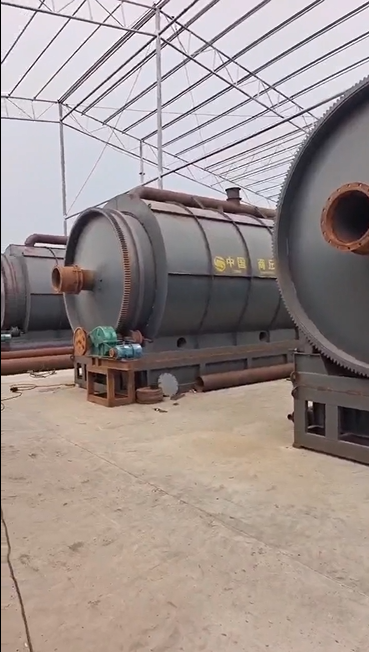
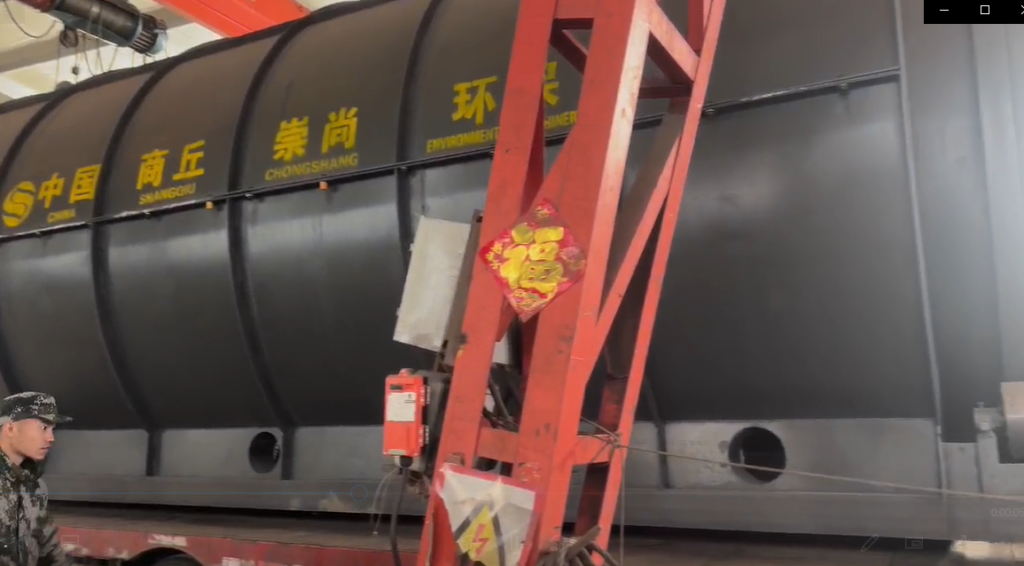
For the core process, we designed a customized thermal distillation unit sized for approximately 10 tons of feedstock per day.

The used oil is heated in a controlled manner inside the distillation reactor. As the temperature increases, different hydrocarbon fractions are vaporized according to their boiling ranges. The hydrocarbon vapors are then transferred to the condensation system, where they are cooled and collected as recovered oil.

The process is configured to maximize the recovery of the desired middle-distillate fraction while leaving heavier components behind as bottom residue.

Because used engine oil varies considerably from supplier to supplier, operating conditions can be adjusted according to the feedstock properties rather than using a fixed temperature profile for every batch.

Condensation and Product Collection

The condensation section uses staged cooling to efficiently recover hydrocarbon vapors. This reduces unnecessary vapor losses and improves overall oil recovery.

The recovered liquid is collected in dedicated storage tanks, where the customer can conduct further filtration, settling, blending, or additional treatment according to the final application.

Residue Management

Heavy residue generated during the distillation process is discharged separately. Depending on its final composition and local regulations, it may be further processed or sent for approved disposal or recovery.

The design therefore focuses on recovering usable hydrocarbon fractions while maintaining controlled handling of the remaining waste.

Safety and Operation

The 10 TPD system was designed with temperature monitoring, pressure control, emergency shut-off functions, insulated hot sections, and dedicated storage connections.

The objective was to provide a system that local operators could understand and maintain without requiring an unnecessarily complicated operating structure.

The final configuration should always be matched with the customer’s actual feedstock analysis, local permitting requirements, and intended end use of the recovered fuel.

Project Results

ScreenShot 2026 09 16 143929 338
ScreenShot 2026 09 16 150454 537
ScreenShot 2026 09 16 150443 690
ScreenShot 2026 09 16 150503 833
ScreenShot 2026 09 16 151021 776
ScreenShot 2026 09 17 155941 463
PyrolysisUnit ISO CE Approved

ISO CE Approved

The equipment quality has passed IAF, CNAS, ISO, CE certifications, Certified by international professional organizations, the equipment is safe and reliable.

PyrolysisUnit AAA Credit Audited Enterprise

AAA Credit Audited Enterprise

One of the top refining equipment manufacturers in China, The government Audited Superb as AAA credit company (top level).

PyrolysisUnit Solutions for Pyrolysis And Distillation

Solutions for Pyrolysis And Distillation

We will provide you with the latest industry solutions, and provide you with a one-year after-sales warranty to ensure stable operation of the equipment.

PyrolysisUnit 24-hour service

24-hour service

We have professional engineers to solve various problems for you, including equipment, process, material problems, etc.

PyrolysisUnit Professional R&D team

Professional R&D team

We have obtained a number of utility model patents, including distillation production equipment and pyrolysis module equipment.

PyrolysisUnit Fast Delivery

Fast Delivery

We have sufficient stock of pyrolysis and distillation equipment to ensure efficient logistics and fast delivery.

Production Results

Based on the project’s target feedstock and a representative test condition, the expected material balance for 10 tons of used engine oil is approximately:

ItemRepresentative Result
Feedstock capacity10 tons/day
Recovered distillate8.0–8.3 tons/day
Representative oil yieldAbout 82%
Heavy residue and lossAbout 13–15%
Water/light componentsAbout 3–5%
Operating schedule300 days/year

At an approximately 82% distillation yield, processing 10 tons of used engine oil can produce about:

10 tons × 82% = 8.2 tons/day of recovered distillate

The actual yield will depend on the composition of the incoming used oil, especially its water content, sludge content, additives, and heavy hydrocarbon fraction.

Representative Product Performance

The recovered product is positioned as a non-standard diesel-type distillate, rather than automatically being treated as on-road commercial diesel. Final use should follow local regulations and laboratory testing.

A representative target range for the recovered middle-distillate fraction is:

ParameterRepresentative Target
AppearanceClear to dark yellow/brown liquid
Density at 20°CApprox. 0.82–0.86 g/cm³
Kinematic viscosity at 40°CApprox. 2.5–4.5 cSt
Water content after treatmentTypically below 0.1%
SedimentLow after filtration/settling
Main applicationIndustrial and non-road fuel applications, subject to testing

These values are engineering reference values, not a substitute for an actual laboratory certificate. Final fuel specifications should be confirmed by independent testing of the customer’s recovered product.

Simple Investment and Revenue Estimate

For a basic commercial calculation, the following assumptions can be used:

Financial ItemAssumption
Plant capacity10 tons/day
Operating days300 days/year
Recovered oil yield82%
Recovered oil production8.2 tons/day
Assumed recovered oil selling priceUS$450/ton
Used oil purchase/collection costUS$100/ton
Processing costUS$70/ton feedstock
Estimated plant + auxiliary investmentUS$220,000

Estimated Annual Revenue

Recovered oil:

8.2 tons/day × US$450 × 300 days = US$1,107,000/year

Potential residue recovery value can add a small amount depending on local disposal and recycling arrangements. For a conservative calculation, this additional revenue is not included in the main calculation.

Estimated Annual Operating Cost

Feedstock cost:

10 tons/day × US$100 × 300 days = US$300,000/year

Processing cost:

10 tons/day × US$70 × 300 days = US$210,000/year

Estimated total operating cost:

US$510,000/year

Estimated Annual Operating Profit

US$1,107,000 − US$510,000 = approximately US$597,000/year

Simple Investment Return

Assuming a total initial project investment of approximately US$220,000:

Simple annual ROI = US$597,000 ÷ US$220,000 × 100% ≈ 271%

Estimated simple payback period:

US$220,000 ÷ US$597,000 ≈ 0.37 year, or about 4.4 months

These figures are illustrative project economics rather than audited customer financial results. Actual profitability will change with feedstock acquisition cost, recovered oil quality, selling price, operating hours, labor, energy costs, maintenance, transportation, taxes, and local regulatory requirements.


Other Cases

Project Conclusion

The Côte d’Ivoire 10 TPD used engine oil distillation project demonstrates how a relatively compact waste oil recovery system can convert difficult-to-handle used lubricating oil into a reusable hydrocarbon product.

The main advantages of the proposed solution are its moderate processing capacity, straightforward operating concept, controlled product recovery, and flexible configuration for variable waste-oil feedstock.

For this type of project, the key to long-term performance is not only the distillation equipment itself. Feedstock quality, pretreatment, temperature control, condensation efficiency, product testing, residue management, and regulatory compliance all have a direct impact on operating results.

Côte d’Ivoire is continuing to strengthen its regulatory framework for used-oil collection, treatment, recovery, and traceability, which makes proper process design and compliance an important part of any commercial project.

For investors processing approximately 10 tons of used engine oil per day, a properly designed distillation system can provide a practical route for recovering useful hydrocarbon fractions while reducing the volume of waste requiring final disposal.

Scroll to Top