How To Make Biochar
At Pyrolysis Unit, we get a lot of questions about how our machines work. People want to know: “How do I turn old wood or farm waste into something useful?” The answer is pyrolysis biochar production.
In this guide, we are going to break it all down. We will use simple words and skip the confusing science talk. Whether you are a farmer, a business owner, or just curious about the environment, this post is for you.
Biochar may be regarded as charcoal; however, not ordinary barbecue charcoal but something that is specifically developed to improve the quality of the soil. Biochar refers to black and crumbly substance filled with carbon.
People knew from early times that adding the burnt wood to soil improves its fertility. Currently, this process became easier due to the use of modern technologies and our Pyrolysis Unit systems.
This charcoal serves as a sort of soil “sponge,” which allows to retain the needed moisture and nutrients for plants, making the latter absorb them whenever they are needed. Moreover, biochar lasts long in the soil, which is essential to prevent climate changes and keep CO2 away from the atmosphere.
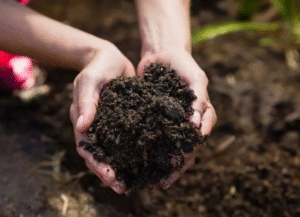
What is good about pyrolysis is that you can use all kinds of waste products that people would otherwise classify as “rubbish.” In the industry, these types of products are referred to as “biomass.”
The following items can be processed by the Pyrolysis Unit machine:
Wood waste: Branches, wood shavings, and wood pallets that are no longer needed.
Farm waste: Waste from corn stalks, rice husks, or coconut shells.
Manure: Dried-up manure can be converted into excellent biochar.
Green waste: Cut grass and leaf litter.
Rather than allowing such materials to rot or being burned in the open air, they can be converted into highly valued biochar.
To make biochar, you have to heat biomass to a very high temperature. But there is one big catch: you cannot have any oxygen.
If you burn wood in a regular fire, it turns to ash. That is because oxygen in the air helps the fire consume everything. But in pyrolysis, we heat the material in a sealed chamber. Because there is no oxygen, the wood doesn’t catch fire and disappear. Instead, it “bakes” and turns into pure carbon.
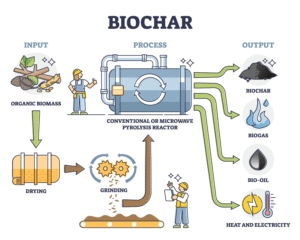
Shutterstock
Think of it like baking a cake. If you leave a cake in the oven too long, it turns black and hard. That is essentially what we are doing to biomass—just at a much higher temperature and in a special machine.
Now we will explain the operation of the Pyrolysis Unit. It is a process involving heating and controlled timing.
Stage One – Material Drying
Biomass contains a lot of water. In case you tried to burn wet wood, you probably know that much energy is required. Therefore, most pyrolysis units first dry the material thoroughly.
Stage Two – Material Intake
Once dried, biomass enters the pyrolysis reactor. It is the core part of the whole unit. It is a strong metal cylinder capable of heating up to extremely high temperatures.
Stage Three – Heating (Pyrolysis)
This stage consists in heating up the reactor. The usual temperature range is from 400°C to 700°C. Being heated without oxygen, biomass begins to decompose chemically.
Stage Four – Gas and Liquid Separation
While baking in the reactor, biomass decomposes releasing the gas called syngas. Syngas doesn’t escape because it has its value; some of it helps maintaining the required temperature saving energy. We also obtain such liquids as wood vinegar or bio-oil.
Step 4: Separating the Gas and Liquid
As the biomass bakes, it releases gases. We call this syngas. We don’t let this gas escape! We catch it. Some of it can be used to keep the machine hot, which saves money on fuel. We also get a liquid called wood vinegar or bio-oil, which has its own uses.
Step 5: Cooling the Biochar
Once the process is done, the solid material left behind is biochar. It is very hot, so it needs to be cooled down. Often, we use a little bit of water or a cooling screw to bring the temperature down safely.
Step 6: Collection
The finished biochar is collected and bagged. It is now ready to be put into the soil or sold!
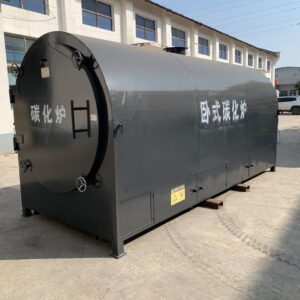
You could technically make biochar in a hole in the ground, but it would be messy and slow. A professional Pyrolysis Unit machine makes a huge difference.
Consistency: Our machines make sure every piece of biochar is the same high quality.
Efficiency: We recycle the gases to heat the machine, which means you use less energy.
Safety: Dealing with high heat and no oxygen can be dangerous if not done right. Our units are built with the best safety tech.
Environment: Our machines have filters to make sure no dirty smoke goes into the sky. It is a “closed-loop” system.
Why are so many people interested in biochar production right now? Because it solves three problems at once.
Problem | Biochar Solution |
Too much waste | Turns farm and wood waste into a product. |
Poor soil quality | Helps soil hold water and vitamins for plants. |
Climate Change | Traps carbon in the ground for hundreds of years. |
Agricultural Advantages of Biochar
Farmers favor biochar since it requires less fertilizers from them. Being porous (having lots of little cavities), biochar prevents the fertilizer from washing away and keeps it closer to the root systems of crops.
Water Conservation
Biochar is very beneficial for arid regions since its pore structure allows for moisture retention, making the survival of crops easier during droughts.
Protecting the Environment
As plants decompose, they give off carbon dioxide. Converting the organic matter into biochar means that the carbon is being stored in a stable form. This process is probably the best way to reduce the Earth’s temperature at this point.
Making biochar is a win-win. You take waste, you make a product that helps plants grow, and you help the earth. At Pyrolysis Unit, we are proud to build the machines that make this possible.
Our machines are built to be tough, easy to use, and very efficient. Whether you are starting a small local project or a large industrial plant, we have the right setup for you.