Sulfur Content Of Pyrolysis Oil
Sulfur is one of the key chemical impurities in fuels. It can cause engine wear, damage emission-control equipment, and create sulfur dioxide emissions when burned. Many fuel standards set strict sulfur limits. For diesel, a commonly cited target is 15 parts per million (ppm) sulfur. When we handle pyrolysis oil, knowing how much sulfur is present is essential for deciding what processing is needed and whether the oil can be used directly as fuel or must be upgraded.
This article explains where sulfur in pyrolysis oil comes from, how distillation affects sulfur levels, and why it is difficult for simple distillation alone to reach 15 ppm. It also reports our measured result: the Pyrolysis Unit distiller produces a diesel-range fraction with about 350 ppm sulfur after distillation. Finally, we outline practical ways to lower sulfur further.
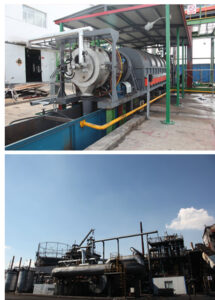
Sulfur in pyrolysis oil appears in many chemical forms. The main types you will see are:
Mercaptans (thiols) — these are simple sulfur compounds that smell strong.
Sulfides and disulfides — molecules where sulfur links carbon chains.
Thiophenes and benzothiophenes — ring-shaped sulfur compounds. These are common when feedstock contains aromatics or materials that form rings under heat.
Where does this sulfur come from? It mainly comes from the feedstock we pyrolyze. Common sources include:
Used engine oils and lubricants — these often have additives that contain sulfur.
Heavy oils and residues — these can carry a lot of sulfur.
Certain plastics and rubbers — some polymers or their additives contain sulfur.
Contaminants mixed with feedstock — food waste, biomass, or other wastes can introduce sulfur too.
The exact mix of sulfur compounds depends on the feedstock and the conditions in the pyrolysis process. Some sulfur compounds are volatile and move into light fractions; others are less volatile and stay with heavier fractions.
Distillation separates oil into fractions based on boiling points. It is useful to split raw pyrolysis oil into light, middle (diesel-like), and heavy fractions. What does distillation do to sulfur?
Partial removal: Distillation can remove some sulfur by sending very light or very heavy sulfur compounds into other fractions. If a sulfur compound mostly boils below the diesel range, it will leave the diesel cut. If it boils above the diesel range, it will also be left out. Distillation helps when sulfur compounds have boiling points that differ noticeably from diesel-range hydrocarbons.
Limited effectiveness on similar-boiling compounds: Many sulfur compounds, especially thiophenes and benzothiophenes, have boiling ranges similar to diesel hydrocarbons. These compounds will co-distill with diesel-range fractions. Because they boil at similar temperatures, simple physical separation by boiling point cannot remove them.
No chemical change: Distillation does not change sulfur chemically. It only redistributes sulfur between cuts. If sulfur is chemically bound or present in compounds that behave like diesel, distillation will not reduce total sulfur in the diesel fraction to very low levels.
In short: distillation helps to a point. It can reduce sulfur when the sulfur compounds favor other boiling ranges. But if the main sulfur species co-boil with the diesel cut, distillation alone will leave significant sulfur behind.
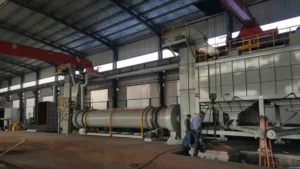
The target of 15 ppm sulfur in diesel is very low. Meeting that standard matters in many markets because modern engines and emission systems require ultra-low sulfur fuels. Can distillation get us there?
The short answer: not usually. Here’s why, in plain terms.
Many sulfur compounds co-boil with diesel. Thiophenes and related ring sulfur compounds often have boiling points overlapping the diesel range. Distillation cannot separate two compounds that boil at essentially the same temperature.
Distillation is a physical, not a chemical, process. It moves molecules around but does not remove sulfur atoms from molecules. To lower sulfur to single-digit ppm, you normally need chemical treatment that either removes sulfur atoms or turns sulfur compounds into something that can be separated.
Initial sulfur levels matter. If the raw oil starts with hundreds or thousands of ppm, distillation might lower that number noticeably, but going from hundreds to 15 ppm is a large reduction. That size of drop usually requires more than fractionation.
Trace-level control is hard. Getting to tens of ppm — and especially to 15 ppm or lower — means controlling trace impurities. Distillation columns and simple batch distillers are not designed for that level of purity without additional polishing steps.
Equipment and operating limits. Industrial hydrodesulfurization units use hydrogen, high pressure, and catalysts to reach 15 ppm or lower. Those systems are expensive and complex. Simple distillers or fractional columns cannot substitute for that chemistry.
So, while distillation improves product quality and can produce a diesel-range cut that is useful for further upgrading, it is generally not enough by itself to meet the 15 ppm diesel sulfur standard.
To be concrete about our own equipment: after distillation with the Pyrolysis Unit distiller, the diesel-range fraction shows a sulfur level of about 350 ppm.
That number reflects the combined effect of our feedstock mix and the capabilities of distillation. It is a meaningful improvement over many untreated raw pyrolysis oils, but it is still well above the 15 ppm limit for ultra-low-sulfur diesel.
What does 350 ppm mean in practice?
It’s low enough for some industrial or heating uses where ultra-low sulfur is not required.
It is not low enough for road diesel in jurisdictions that require 15 ppm (or similar ultra-low sulfur limits).
It signals that further upgrading is necessary if the aim is to sell as road diesel or to meet strict emissions regulations.
Reporting this measured value is useful for planning next steps. It tells engineering and product teams how much additional desulfurization work is required to hit tighter limits.
If the goal is to move from 350 ppm toward 15 ppm, distillation alone won’t do it. Below are the common additional methods. Each has tradeoffs in cost, complexity, and feedstock needs.
A. Hydrodesulfurization (HDS)
How it works: Hydrogen reacts with sulfur compounds over a catalyst to form hydrogen sulfide (H₂S), which is removed.
Pros: Proven industrial method; can reach very low sulfur levels with the right conditions.
Cons: Requires hydrogen, high pressure, specialized catalysts, and safety systems. Capital and operating costs are high.
B. Catalytic dearomatization / catalytic cracking with desulfurizing catalysts
How it works: Catalysts and process conditions break sulfur-containing rings or transform sulfur species so they can be removed.
Pros: Can be effective when tailored to feedstock.
Cons: May require reactor complexity and careful catalyst choice.
C. Adsorption and sorbents (activated carbon, metal oxides)
How it works: Sulfur compounds adhere to adsorbent surfaces and are removed from the liquid.
Pros: Lower temperature, simpler equipment than HDS.
Cons: Adsorbents saturate and need regeneration or replacement. Effectiveness varies by sulfur species; refractory thiophenes are harder to adsorb.
D. Oxidative desulfurization (ODS)
How it works: Sulfur compounds are oxidized to sulfones or sulfoxides. These oxidized forms can then be removed by extraction or adsorption.
Pros: Works at lower temperature and pressure than HDS. Can be effective on certain sulfur species.
Cons: Uses oxidants and usually needs an extraction step. Handling and disposal of by-products require care.
E. Extractive desulfurization (solvent extraction, ionic liquids)
How it works: A solvent or ionic liquid selectively dissolves sulfur compounds away from the hydrocarbon phase.
Pros: Can target specific sulfur species; works under milder conditions.
Cons: Solvent recovery required; costs and solvent life are factors.
F. Biodesulfurization (experimental)
How it works: Microbes or enzymes remove sulfur from molecules.
Pros: Low temperature and green appeal.
Cons: Still early-stage for commercial-scale heavy-duty fuel desulfurization; slow and sensitive to contaminants.
Practical route suggestions
For industrial-scale production aimed at meeting 15 ppm, HDS or a hybrid process that includes HDS is the most reliable choice.
For smaller operations or pilot upgrades, adsorption or oxidative + extractive methods may be feasible as polishing steps after distillation.
Always test the diesel-range cut after each treatment to confirm sulfur reduction and watch for other property changes (cetane, density, stability).
Testing and measurement
Accurate sulfur measurement is essential. Typical lab approaches include:
Use standardized methods to report sulfur in ppm.
Measure the raw oil, each distillation cut, and the final treated product.
Track not only total sulfur but also sulfur speciation if possible (to know which sulfur types remain).
Routine steps we recommend:
Collect representative samples and homogenize before testing.
Run a total sulfur test on the diesel-range fraction right after distillation.
If sulfur remains high, run speciation or GC analyses to find which sulfur compounds are present. That helps pick the right downstream treatment.
Repeat tests after any additional treatment and record results for process control.
Sulfur in pyrolysis oil comes from feedstock and forms several compound types. Distillation improves product quality but cannot remove sulfur that co-boils with diesel-range hydrocarbons. Because of this, reaching ultra-low sulfur levels such as 15 ppm by distillation alone is generally not possible. Our Pyrolysis Unit distiller produces a diesel-range fraction that measures about 350 ppm sulfur. That figure means further desulfurization is required if the product must meet strict road-diesel standards.
To get much lower sulfur, consider additional steps like hydrodesulfurization, adsorption, oxidative and extractive methods, or a combination. The right choice depends on production scale, cost limits, and the sulfur species present in the distillate. Accurate testing before and after each step is essential for good results.