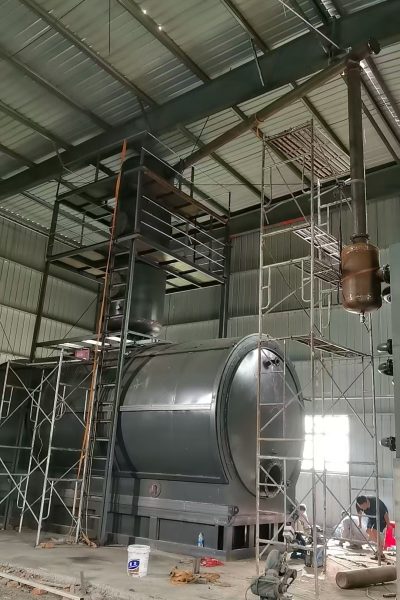

Distillation Equipment Project in Malaysia In February 2026, a waste-tire
10-Ton-Per-Day Waste Oil Distillation Facility
April 2026: 10-Ton-Per-Day Waste Oil Distillation Facility in Phnom Penh, Cambodia
Project Background
In April 2026, a private recycling investor in Phnom Penh, Cambodia commissioned a 10-ton-per-day waste oil distillation plant to convert used lubricating oil and mixed waste oil into marketable industrial fuel. The client’s goal was straightforward: reduce disposal pressure from growing volumes of waste oil, build a stable local supply of recovered fuel, and create a business that could operate reliably in Cambodia’s expanding industrial and transport sectors.
Before the project, the client was collecting waste oil from garages, transport fleets, and small factories, but much of it was being handled inefficiently or sold at low value. The new plant was designed to improve both environmental compliance and commercial return. The site also had to be adapted to Phnom Penh’s local operating conditions, including stable utility access, seasonal heat, logistics for incoming feedstock, and the need for simple operation with a manageable labor team.


Professional Solution Tailored for the Client
After reviewing the client’s feedstock quality, storage conditions, target product market, and available site space, a customized continuous waste oil distillation solution was recommended. The plant was designed around a 10-ton daily processing capacity with a layout that separated pretreatment, distillation, condensation, gas recovery, finished product storage, and residue handling into clear functional zones. This helped reduce contamination risks and made daily operation easier for the local team.
To improve product consistency, the solution included a multi-stage pretreatment system for water removal, solids filtration, and light impurity separation before distillation. This step was important because the waste oil collected in Phnom Penh came from different sources and had uneven quality. The distillation section was configured to recover a stable hydrocarbon fraction suitable for industrial fuel use, while the heating system was selected to balance thermal efficiency, fuel consumption, and maintenance convenience.
The project also emphasized operational safety and long-term reliability. Explosion protection, temperature monitoring, pressure control, emergency shutdown functions, and proper gas recycling were integrated into the design. In addition, the layout included easy access for maintenance, which is critical for a plant expected to run near full capacity for most of the year.
For the client’s business model, the plant was positioned not only as a processing facility but also as a local fuel recovery center. The recovered product could be sold to industrial users, boiler operators, and trading partners in the surrounding market. This gave the client both environmental value and a practical path to revenue growth. Training was also provided to the operating team so they could manage feedstock sorting, startup procedures, temperature control, residue discharge, and routine inspection without relying heavily on external technical support.
Project Results

ISO CE Approved
The equipment quality has passed IAF, CNAS, ISO, CE certifications, Certified by international professional organizations, the equipment is safe and reliable.

AAA Credit Audited Enterprise
One of the top refining equipment manufacturers in China, The government Audited Superb as AAA credit company (top level).

Solutions for Pyrolysis And Distillation
We will provide you with the latest industry solutions, and provide you with a one-year after-sales warranty to ensure stable operation of the equipment.

24-hour service
We have professional engineers to solve various problems for you, including equipment, process, material problems, etc.

Professional R&D team
We have obtained a number of utility model patents, including distillation production equipment and pyrolysis module equipment.

Fast Delivery
We have sufficient stock of pyrolysis and distillation equipment to ensure efficient logistics and fast delivery.
Because this is a waste oil distillation project rather than a waste tire pyrolysis project, the equivalent performance metrics are shown below:
- Annual waste oil processing capacity: 10 tons/day × 300 operating days = 3,000 tons/year
- Average fuel recovery rate: 85%
- Annual fuel output: 3,000 tons × 85% = 2,550 tons/year
Simple financial calculation
- Total investment cost: USD 980,000
- Plant equipment, installation, commissioning, tank system, electrical control, and safety system
- Average selling price of recovered fuel: USD 760/ton
- Annual revenue: 2,550 tons × 760 = USD 1,938,000
- Estimated annual operating cost: USD 1,240,000
- Feedstock collection, labor, power, maintenance, consumables, and administration
- Estimated annual net profit: 1,938,000 − 1,240,000 = USD 698,000
- ROI: 698,000 ÷ 980,000 × 100% = 71.2%
These results indicate that the plant achieved strong commercial performance while also helping the client turn low-value waste oil into a consistent revenue stream.
Waste Plastic-to-Fuel Refining Equipment Two Sets of Waste Plastic-to-Fuel Refining
Conclusion
The Phnom Penh project demonstrates how a properly designed waste oil distillation plant can combine environmental responsibility with solid financial returns. With stable feedstock supply, careful pretreatment, and efficient distillation control, the client built a reliable recovery system that supports both local waste management and long-term business growth.