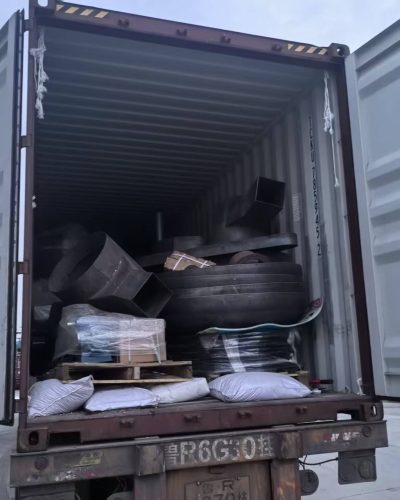

Distillation Equipment Project in Malaysia In February 2026, a waste-tire
60 Ton Per Day Tire Processing Facility In Ghana
Dated November 2025, Focusing On A 60-Ton-Per-Day Tire Processing Facility In Ghana, Africa
Introduction
In November 2025, a waste-management and recycling company in Ghana commissioned a 60-ton-per-day tire processing facility to address the country’s growing stockpile of end-of-life tires from transport fleets, mining operations, and urban collection points. The client’s goal was to convert a difficult waste stream into saleable products while building a stable local supply chain for recovered fuel, steel, and carbon-based byproducts. The project was planned for a strategic industrial zone with good road access, allowing steady inbound tire delivery and outbound product logistics to ports and domestic buyers.


Professional Solution Tailored for the Client
To meet the client’s operational and commercial goals, a fully integrated tire recycling system was designed around continuous feeding, stable heat control, and high product recovery. The front end of the plant included a receiving yard, manual inspection area, bead removal, and primary shredding to reduce tire size and protect downstream equipment. A magnetic separation stage was added to recover steel early and improve reactor efficiency.
The core of the plant consisted of two 30-ton-per-day continuous pyrolysis lines, allowing the facility to process 60 tons per day with better uptime and easier maintenance scheduling than a single larger line. This arrangement also gave the client flexibility to run one line during maintenance or lower feedstock periods. The reactor system was equipped with automated temperature control, sealed feeding, and controlled discharge to improve oil yield consistency and reduce operator dependence.
A multi-stage condensation and oil recovery system was configured to capture tire-derived oil efficiently, while non-condensable gas was recycled back into the furnace to reduce external fuel consumption. The flue-gas treatment package included dust removal, scrubbing, and odor control to help the plant meet local environmental expectations and maintain better community acceptance. In addition, the char handling section was designed for safe cooling, packaging, and storage so that recovered carbon black could be sold into industrial applications where appropriate.
The engineering package also included operator training, spare parts provisioning, and a preventive maintenance plan. This was important for the Ghanaian market, where stable operation, local serviceability, and simple maintenance routines can be more valuable than complex automation alone. The final solution gave the client a system that was commercially attractive, operationally practical, and scalable for future expansion.
Project Results and Performance Evaluation

ISO CE Approved
The equipment quality has passed IAF, CNAS, ISO, CE certifications, Certified by international professional organizations, the equipment is safe and reliable.

AAA Credit Audited Enterprise
One of the top refining equipment manufacturers in China, The government Audited Superb as AAA credit company (top level).

Solutions for Pyrolysis And Distillation
We will provide you with the latest industry solutions, and provide you with a one-year after-sales warranty to ensure stable operation of the equipment.

24-hour service
We have professional engineers to solve various problems for you, including equipment, process, material problems, etc.

Professional R&D team
We have obtained a number of utility model patents, including distillation production equipment and pyrolysis module equipment.

Fast Delivery
We have sufficient stock of pyrolysis and distillation equipment to ensure efficient logistics and fast delivery.
After commissioning and stabilization, the facility was rated for 60 tons/day of tire feedstock. Based on 330 operating days per year, the plant achieved an annual processing capacity of:
60 tons/day × 330 days = 19,800 tons/year
The average product yield stabilized at approximately 43% pyrolysis oil, which gave an annual fuel output of:
19,800 tons/year × 43% = 8,514 tons/year of fuel oil
Assuming a diesel-like fuel oil density, this is roughly 9.1 million liters per year.
A simplified financial model for the facility is shown below:
Estimated annual revenue
- Pyrolysis oil: 8,514 tons × USD 430/ton = USD 3,660,?
= USD 3,660,? - Recovered steel: 2,376 tons × USD 180/ton = USD 427,680
- Carbon black / char: 6,534 tons × USD 95/ton = USD 620,730
Using the above assumptions, the total annual revenue is approximately:
USD 4,709,430
Estimated annual operating cost
- Labor, utilities, maintenance, consumables, logistics, and administration:
USD 2,850,000
Estimated annual net profit
USD 4,709,430 − USD 2,850,000 = USD 1,859,430
Total investment cost
- Civil works, equipment, installation, commissioning, and working capital:
USD 5,800,000
ROI calculation
ROI = (Annual Net Profit ÷ Total Investment) × 100%
ROI = (1,859,430 ÷ 5,800,000) × 100% = 32.1%
At this level of performance, the project’s simple payback period is approximately 3.1 years, which is considered attractive for a heavy industrial recycling project in West Africa.
Waste Plastic-to-Fuel Refining Equipment Two Sets of Waste Plastic-to-Fuel Refining
Conclusion
This Ghana tire processing project demonstrated how a well-engineered 60-ton-per-day facility can turn waste tires into reliable industrial value. With stable feedstock supply, strong oil recovery, and balanced byproduct sales, the plant achieved solid operating economics and a competitive return on investment. The project provides a practical model for large-scale tire recycling in Africa, combining environmental impact with long-term commercial viability.