What Is A Biomass Pyrolysis Plant?
If you run a farm, a sawmill, a rice mill, or a food processing site, you already know the problem. Waste piles up fast. Rice husks, wood scraps, straw, or shells sit around taking up space, and hauling them away costs money every time.
You may have come across the term “biomass pyrolysis plant” while looking for a better option. But what does that machine actually do, and how does it turn waste into something you can use or sell? I have spent years around this kind of equipment, and I want to walk you through it here in plain language, one step at a time.
What Is a Biomass Pyrolysis Plant?
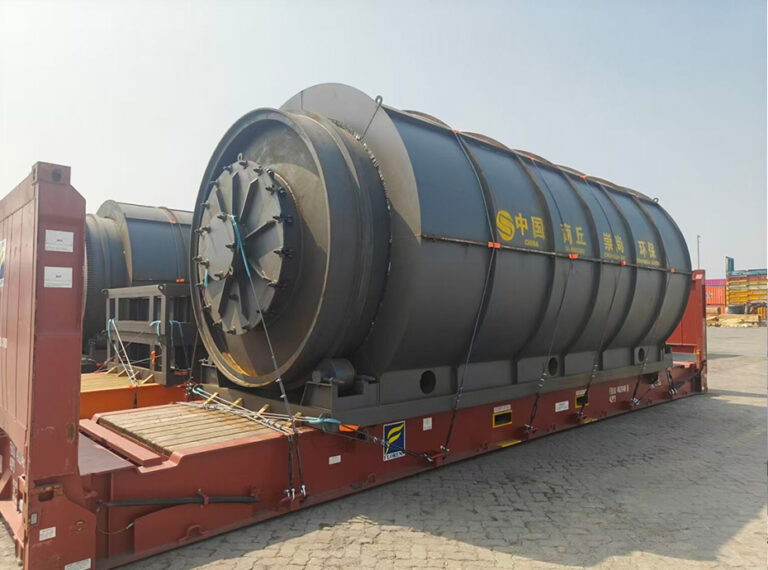
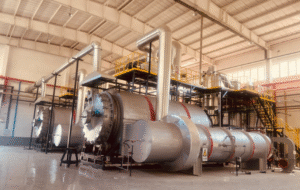
In simple terms, a biomass pyrolysis plant is a machine that heats organic waste inside a sealed chamber with little or no oxygen. Researchers describe biomass pyrolysis as heating biomass without air, usually somewhere around 500°C, which breaks the material down into gas, liquid, and a solid called biochar (ScienceDirect). Because there is almost no oxygen inside the chamber, the material cannot catch fire the way it would in an open burn pile. Instead, heat alone pulls the chemical bonds apart.
Biomass itself is just organic matter from plants. Wood, straw, husks, shells, and stalks all count. Inside these materials are a few main building blocks. Cellulose and hemicellulose give plants their shape. Lignin is the tough, woody part that holds everything together. When you heat these compounds in a low-oxygen space, they break into smaller molecules. That breakdown, start to finish, is what people mean by pyrolysis.
So how does a pile of rice husks or wood scraps actually turn into biochar, oil, and gas? Let’s walk through it.
How Does a Biomass Pyrolysis Plant Work?
Most systems follow the same basic sequence, even though the equipment design varies from one manufacturer to the next.
- Drying and shredding.Wet biomass wastes energy and slows the reaction down, so most plants call for moisture content under about 15 percent. The material also gets shredded into small, even pieces so it heats evenly instead of scorching on the outside while staying raw in the middle.
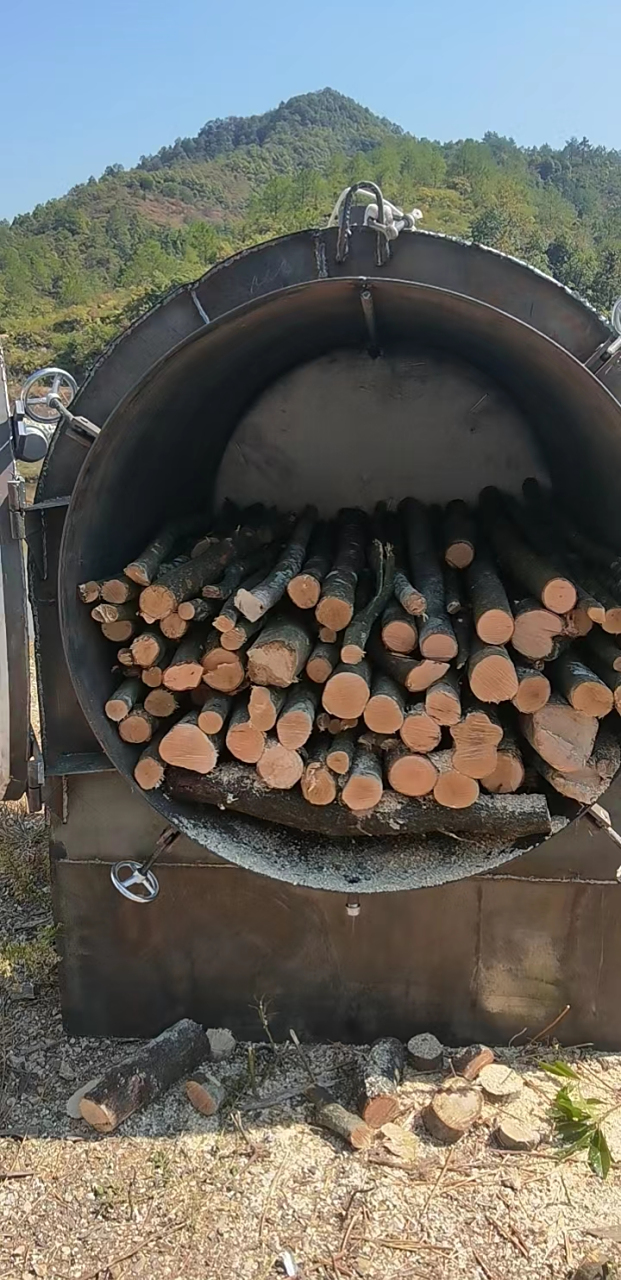
- Feeding the reactor.A conveyor or screw feeder moves the prepared biomass into a sealed reactor chamber, which is purged of oxygen before heating begins.
- Heating in stages.The reactor raises the temperature step by step. It drives off any last moisture first, then breaks down the easier compounds, and finally cracks apart the tougher cellulose and lignin.
- Separating the outputs.As the biomass breaks down, solid char settles out, while hot vapor moves on to a condenser. Part of that vapor cools into liquid, and the rest stays behind as gas.
- Cooling and discharge.The finished biochar passes through a water-cooled system before it gets collected, since hot char can catch fire if it meets air too soon.
Here is roughly what happens to the temperature as biomass moves through a typical reactor:
Stage | Approximate Temperature | What’s Happening |
Drying | 100–150°C | Remaining moisture evaporates |
Early breakdown | 150–300°C | Easily broken compounds release gases such as CO2 |
Main reaction | 300–650°C | Cellulose and lignin break down into char, liquid, and gas |
Cooling | Below 100°C | Char cools down so it will not re-ignite |
These numbers shift depending on the equipment and the feedstock, so treat the table as a general guide rather than a fixed rule.
What Types of Biomass Pyrolysis Are There?
Not every biomass pyrolysis plant is built for the same job. The three main categories differ mainly in how fast they heat the material and how long it stays hot. That second number is called residence time, and it simply means how long the material sits at peak temperature before it moves on.
Type | Heating Rate | Typical Temperature | Residence Time | Main Product |
Slow (carbonization) | Low | Roughly 300–650°C | Hours, sometimes longer | Biochar |
Conventional | Moderate | Below about 500°C | A few seconds | Roughly equal parts gas, liquid, and solid |
Fast | Very high | About 400–600°C | Under 2 seconds | Bio-oil, sometimes 60–75% of output by weight |
If your goal is biochar for soil use or carbon credits, slow pyrolysis is usually the better fit, since the long reaction time gives more carbon a chance to lock into a solid form. If your goal is liquid fuel, fast pyrolysis tends to make more sense, since the short reaction time favors liquid over solid.
You may also come across the word “gasification” while researching this topic. It is related to pyrolysis, but it is not the same process. Gasification lets in a small, controlled amount of air or oxygen and usually runs hotter. Pyrolysis, by contrast, keeps oxygen out almost completely. A few reactor designs actually combine both steps: a pyrolysis zone followed by a small oxidation zone that helps sustain the heat.
What Comes Out of a Biomass Pyrolysis Plant?
A biomass pyrolysis plant produces three products, and most plants are designed to make use of all three rather than throwing any of them away.
Product | Form | Common Uses |
Biochar | Solid | Soil amendment, activated carbon, solid fuel |
Bio-oil (also called tar or pyrolysis oil) | Liquid | Industrial fuel, chemical feedstock after refining |
Syngas | Gas (mainly CO, H2, CH4, CO2) | Burned to help power the reactor itself |
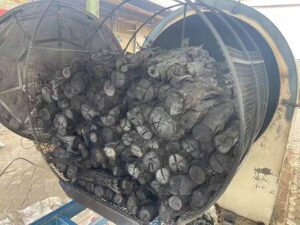
Biochar tends to get the most attention, largely because of its porous structure. That structure gives it a large surface area, which lets it hold onto water and nutrients the way a sponge soaks up water. USDA researchers have even applied biochar at old mine sites to help repair highly acidic soil and cut down on metal toxicity that would otherwise keep plants from growing there (USDA Agricultural Research Service).
Bio-oil is trickier to work with. It carries a lot of oxygen-containing compounds, and it usually needs further refining before it can stand in for conventional fuel. Syngas is the most immediately useful of the three, since many plants burn it on-site, which cuts down on how much outside fuel the reactor needs to keep running.
What Can You Use as Feedstock?
Almost any dry, plant-based material can work, though some need more preparation than others.
Category | Examples |
Wood waste | Sawdust, wood chips, bark, offcuts |
Crop waste | Rice husk, wheat straw, corn stalks, sugarcane bagasse |
Shell and processing waste | Coconut shell, palm kernel shell, peanut shell |
Wondering whether your own waste stream would work? A simple rule of thumb: if the material is dry, plant-based, and can be shredded into small, even pieces, it is probably a workable feedstock. Materials with a lot of dust or loose fiber, like some palm waste, may need extra processing first so they do not clog the feeding system.
Is Biomass Pyrolysis Actually Good for the Environment?
This question is worth answering carefully, since it is easy to overstate.
Left alone, biomass waste does not just disappear. Piled up, it can release methane as it slowly rots. Burned in the open, it releases smoke and CO2 with no energy recovered at all. Routing that same material through a pyrolysis plant recovers usable energy and locks a share of the carbon into biochar instead of letting it return to the atmosphere right away.
According to USDA Climate Hubs, biochar is a stable, carbon-rich material that can persist in soil for years to decades, and its exact properties depend heavily on the feedstock and the temperature used to make it. The U.S. Forest Service has reported that biochar can remain stable in soil for up to a thousand years in some cases, which would make it a genuinely long-term way to store carbon.
That said, a peer-reviewed review on PubMed Central found that many long-term stability claims rest on a fairly limited number of field studies, so real-world results can vary by soil type, climate, and how the biochar was made. Biochar looks genuinely promising, but it is not a guaranteed fix, and the real carbon benefit depends on the details of each project.
On the energy side, biomass already ranks as one of the more significant renewable sources in use today, trailing only coal, oil, and natural gas among global energy sources. Turning waste biomass into usable heat, gas, or oil through pyrolysis is one way to put that resource to work instead of sending it to a landfill.
A Real-World Example
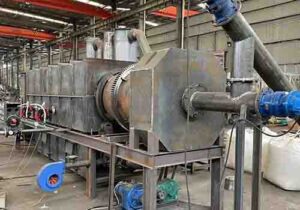
Picture a mid-sized rice mill that produces several tons of husk waste every day. Before installing a pyrolysis unit, a mill like this usually pays to haul that husk away, or burns it in the open, which tends to bring smoke complaints from neighbors. After switching to a continuous slow-pyrolysis reactor, the same husk becomes biochar that can be bagged and sold as a soil amendment, while the syngas produced along the way helps heat the reactor itself. A furniture workshop or sawmill sitting on piles of sawdust and offcuts faces a similar choice, just with a different feedstock.
I have talked with operators running setups like these, and the appeal is rarely just about the environment. It is just as much about turning a disposal cost into something they can sell. Your own numbers will look different depending on how much biomass you generate, how steady that supply is, and what local buyers exist for biochar or bio-oil in your area.
What Should You Check Before You Invest?
A few questions are worth answering honestly before committing to a plant.
Question | Why It Matters |
How much biomass do you generate, and how steady is the supply? | Plants are sized around a feed rate, and gaps in supply leave equipment idle |
Do you have a buyer or use for biochar, bio-oil, or syngas? | The plant only pays for itself if the outputs go somewhere |
What permits and emissions rules apply where you operate? | Air quality and waste-handling rules vary by country and region |
Do you need batch or continuous operation? | Continuous systems handle more volume but usually cost more upfront |
Who will run and maintain the equipment? | Reactors need routine upkeep, so trained operators matter |
None of these questions have a single right answer. A small farm cooperative and a large sawmill will land on different equipment, for reasons specific to their own situation.
Frequently Asked Questions
What temperature does a biomass pyrolysis plant run at? Most systems run somewhere between 300°C and 650°C. The exact number depends on whether the goal is biochar, bio-oil, or a mix of products.
What is the difference between pyrolysis and gasification? Pyrolysis excludes oxygen almost entirely. Gasification allows in a small, controlled amount of air or oxygen and generally runs at a higher temperature.
Is torrefaction the same thing as pyrolysis? Torrefaction is sometimes described as a mild form of pyrolysis. It runs at a lower temperature and mainly prepares biomass for other uses, such as fuel pellets, rather than producing biochar or bio-oil directly.
What can I use as feedstock? Most dry, plant-based waste works, including wood chips, sawdust, rice husk, straw, and shells such as coconut or palm kernel. Moisture content under about 15 percent is typically required.
What products come out of the process? Three: solid biochar, liquid bio-oil (sometimes called tar), and syngas. Many plants burn part of the syngas to help power the reactor itself.
Is biomass pyrolysis considered environmentally friendly? It can reduce open burning and landfill waste, and biochar does store carbon for extended periods. That said, researchers note the actual benefit varies by project, so it is worth being wary of blanket claims in either direction.
How big are commercial biomass pyrolysis plants? Commercial-scale plants generally range from around 5 tons a day on the small end to more than 100 tons a day for larger operations, though sizing depends heavily on feedstock supply.
Closing Thought
A biomass pyrolysis plant is, at its core, a way to turn organic waste into a solid, a liquid, and a gas that you can actually use. The right setup for your situation depends on your feedstock, your local market for the outputs, and how much you are able to invest upfront.
If you are still comparing options, it is worth asking any supplier for the specific temperature range, residence time, and capacity of their equipment. Those three numbers tell you more about how a plant will perform than most marketing material will.