
Table of Contents How Much Does It Cost to Start
Table of Contents
3 Types of Pyrolysis Furnace Insulation Shells Compared: Which One Is Right for Your Project?
When evaluating a pyrolysis plant, most buyers focus on reactor capacity, oil yield, and emission systems. The insulation shell rarely gets attention — until it fails.
The insulation shell surrounds the pyrolysis reactor and serves three critical functions: maintaining stable internal temperatures during pyrolysis (typically 350–600°C), minimizing heat loss to reduce fuel consumption, and protecting external components from thermal damage. A poorly designed insulation shell leads to higher operating costs, inconsistent product yield, and in the worst case, structural collapse during operation.
There are three types of insulation shells currently used in pyrolysis equipment manufacturing. Each has a distinct structure, performance profile, and cost point. This article breaks down all three based on actual engineering data — so you can ask the right questions before purchasing.
Type 1: Refractory Cement Cast Insulation Shell
Structure
The refractory cement cast shell is built from the inside out using the following layers:
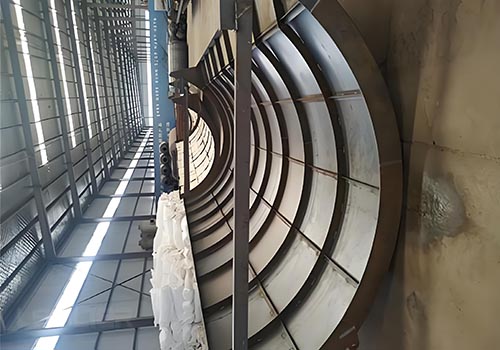
- Inner framework: 12mm steel keels (keel) arranged in a reinforced grid pattern, combined with reinforcing pins (Reinforcing nails) and ceramic fiber blankets
- Cast layer: A mixture of refractory cement, refractory sand, and aggregate, proportioned and poured uniformly throughout the framework
- Total wall thickness: 20–25 cm after curing
- External reinforcement: 14 channel steel bars (Channel steel) welded as an external reinforcement cage around the shell
How It Performs
This design borrows from the structural principles of traditional brick kilns. Refractory castable material behaves differently from most construction materials: under sustained high temperatures, its internal molecular structure gradually densifies rather than weakening. The result is a shell that becomes progressively stronger and more airtight the longer it operates — a property sometimes described as “the more it fires, the more solid it becomes.”
Practical implications:
- High airtightness: The dense cast structure minimizes gas leakage around the reactor, which is critical for maintaining the oxygen-free environment required for pyrolysis
- Excellent insulation: Low thermal conductivity means less heat escapes through the shell walls, reducing external fuel consumption
- Low heat loss: The combination of ceramic fiber blanket and dense cast layer creates an effective thermal barrier
The one limitation: Because the shell retains heat so effectively, cooling time after each production cycle is longer compared to lighter insulation types. PyrolysisUnit addresses this by engineering adjustable heat dissipation vents at the top of the furnace — operators can open these during the cooling phase to accelerate temperature reduction without compromising the shell’s integrity during operation.
Weight and Logistics
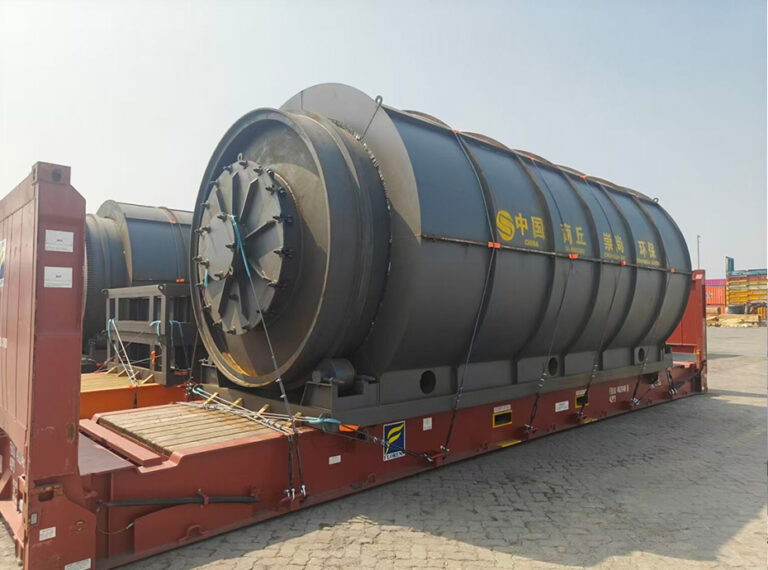
Fully assembled, a refractory cement cast insulation shell weighs approximately 12 tons. This has practical implications for transportation and on-site lifting:
- Heavy-duty cranes are required for installation
- Shipping logistics require appropriate flatbed or lowboy trailers
- Once installed, the shell is effectively permanent — relocation is not practical
Verdict
The refractory cement cast shell is the highest value-for-money option among the three types. Its long service life, superior airtightness, and proven structural durability make it the standard choice for operators prioritizing long-term reliability over initial convenience.
Type 2: Ceramic Fiber Module Insulation Shell (Aluminum Silicate)
Structure
The ceramic fiber module shell uses a fundamentally different construction approach:
- Core material: High-density aluminum silicate (硅酸铝) ceramic fiber modules, pressed into uniform blocks
- Fastening system: Stainless steel reinforcing pins (不锈钢加固钉) embedded through each module to anchor them to the reactor surface
- Total wall thickness: 20–25 cm
- Outer protective layer: A sprayed thermal coating applied to the outermost surface, forming a protective and insulating membrane
- External support framework: Steel keels positioned on the outside of the insulation — not embedded within it
The Engineering Upgrade: External Keel Placement
This detail matters. In older or lower-quality designs, steel support keels are placed inside the insulation layer. The problem: ceramic fiber modules need to be in full, flush contact with each other to perform correctly. Internal keels create gaps at the contact points. During thermal cycling — repeated heating and cooling — these gaps cause the keel to shift, reducing structural support over time.
PyrolysisUnit’s ceramic fiber module shell moves the support framework entirely outside the insulation block. The modules maintain full contact with no internal gaps, and the external support cage provides structural integrity without compromising thermal performance.
Performance
- Thermal performance: Comparable to the refractory cement shell in insulation efficiency, with slightly faster cooling due to lower total thermal mass
- Airtightness: Good, though slightly lower than the dense-cast cement shell due to the modular (jointed) construction
- Weight: Approximately 6 tons — roughly half the weight of the refractory cement version
Advantages
- Significantly easier to lift, transport, and install due to reduced weight
- Faster on-site installation compared to cast shells (no curing time required)
- The modular design allows individual sections to be replaced if damaged, rather than rebuilding the entire shell
Limitation
The manufacturing cost of high-density ceramic fiber modules and the precision required in their installation means this option carries a higher unit cost than the refractory cement version.
Verdict
The ceramic fiber module shell is the premium configuration — appropriate for buyers who prioritize ease of installation, lower transport costs, or who operate in locations where crane capacity is limited.
Type 3: Ceramic Blanket Flat-Lay Insulation Shell
Structure
The blanket flat-lay shell is the simplest of the three:
- Core material: Three layers of ceramic fiber blanket (cotton blanket), laid flat and stacked
- Fastening: Standard reinforcing pins through the blanket layers
- External reinforcement: Flat bar strips (slats) on the outside surface of the blanket stack
- Total wall thickness: Approximately 10 cm — roughly half the thickness of the other two types
- Notable absence: No internal or external steel keel framework
The Structural Problem
This design has a fundamental engineering weakness. During pyrolysis operation, the reactor surface maintains sustained temperatures of 350–600°C. The external bar strips and reinforcing pins are in direct contact — or near-direct contact — with this heat.
Under repeated thermal cycling (heating and cooling), metal components expand and contract. Bar strips and pins without adequate thermal insulation between them and the heat source will experience accelerated stress fatigue. Over time:
- Reinforcing pins become loose or pull out
- External bar strips deform or fracture
- Once the pins fail, the blanket layers lose their anchor points
- The entire insulation shell collapses
This is not a theoretical risk — it is the documented failure mode of flat-lay blanket shells after extended operation.
Where This Type Appears
Blanket flat-lay insulation is typically found on low-cost pyrolysis equipment from manufacturers competing primarily on price. It reduces manufacturing cost significantly, which is its primary — and essentially only — advantage.
Verdict
The blanket flat-lay shell has the lowest upfront cost and the shortest service life. For any serious commercial pyrolysis operation, this option carries unacceptable reliability and safety risks. The cost savings at purchase are typically eliminated by premature shell failure and the associated downtime and repair costs.
Side-by-Side Comparison
| Refractory Cement Cast | Ceramic Fiber Module | Blanket Flat-Lay | |
|---|---|---|---|
| Wall Thickness | 20–25 cm | 20–25 cm | ~10 cm |
| Total Weight | ~12 tons | ~6 tons | Light |
| Airtightness | ★★★★★ Excellent | ★★★★ Good | ★★ Poor |
| Insulation Performance | ★★★★★ | ★★★★ | ★★ |
| Cooling Speed | Slower (vents available) | Medium | Fast |
| Structural Durability | ★★★★★ Long-term | ★★★★ Long-term | ★ Short-term |
| Transport & Lifting | Requires heavy crane | Standard crane | Easy |
| Manufacturing Cost | ★★★ Moderate | ★★★★ Higher | ★ Low |
| Value for Money | ★★★★★ Best overall | ★★★★ Premium | ★ Not recommended |
| Recommended For | Standard commercial use | Sites with crane limits | Not recommended |
Which Insulation Shell Does PyrolysisUnit Use?
PyrolysisUnit’s standard configuration uses the refractory cement cast insulation shell across our batch and semi-continuous pyrolysis machines. This is the configuration we recommend for the majority of commercial waste tire and plastic pyrolysis projects — it delivers the best combination of thermal performance, airtightness, structural longevity, and cost efficiency.
For clients who require easier on-site installation, have crane capacity limitations, or are operating in locations with difficult logistics, we offer the ceramic fiber module shell as an upgrade option. Our engineering team can advise on the appropriate configuration based on your site conditions and operational requirements.
We do not use or offer blanket flat-lay insulation on any of our equipment. We consider it unsuitable for sustained commercial operation.
If you have questions about insulation specifications for a specific model, or want to understand how insulation choice affects long-term operating costs for your project, contact our team directly.
→ Contact PyrolysisUnit for a free technical consultation
Recent Articles

Related Blog