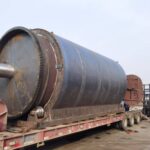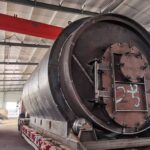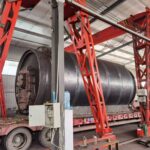

Distillation Equipment Project in Malaysia In February 2026, a waste-tire
North Korea oil sludge pyrolysis project (2021)
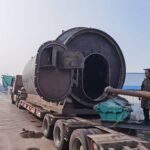
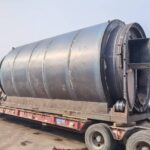
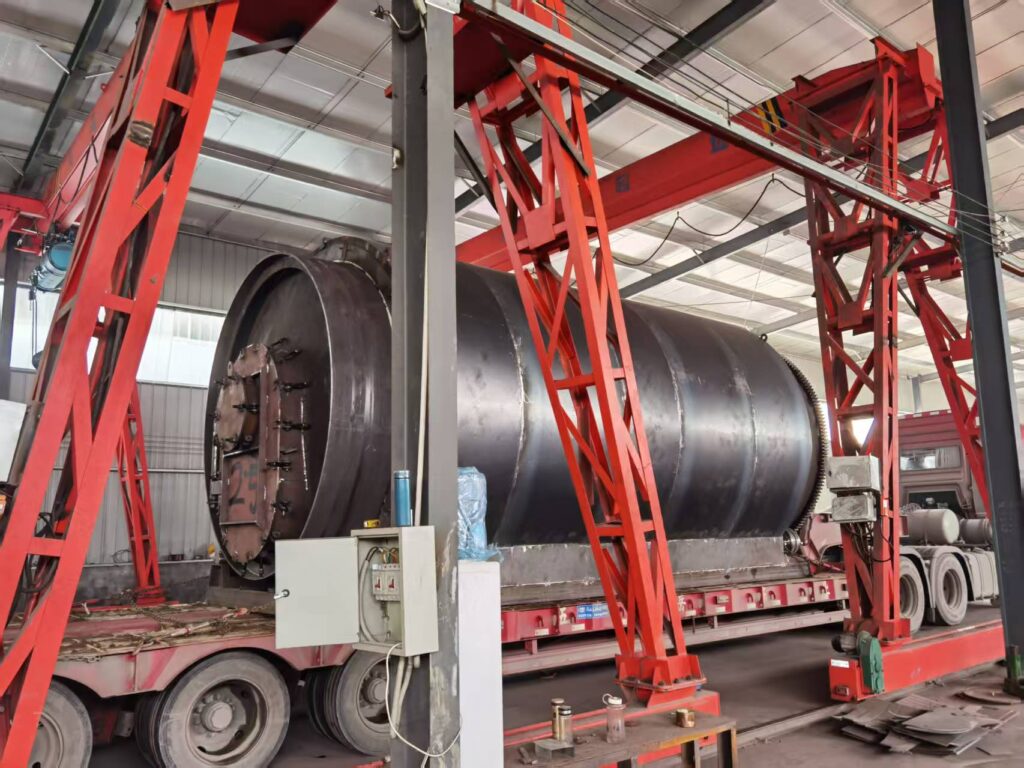
In April 2021, North Korea installed two oil sludge batch pyrolysis units.
In April 2021, an industrial park in North Korea ordered two sets of oil sludge pyrolysis equipment from us. Their goal was to process and transform hazardous oil sludge into usable pyrolysis oil (fuel), recyclable gases, and coke; reduce hazardous waste disposal costs; and produce fuel for on-site use or local sale.
Project Scope: Simultaneous commissioning of two identical batch pyrolysis production lines.
Total design processing capacity: 10-15 tons of oily sludge per day (referring to the total processing capacity of both units). The project includes equipment supply, installation, commissioning, operator training, and equipment performance verification.


Configuring Solutions For Clients
Standard Technical Solution Developed
- Two batch pyrolysis reactors, sized to process 10-15 tons of oily sludge per day.
- Pre-treatment: Simple dewatering + removal of coarse solids to reduce feed moisture content to <10%.
- Pyrolysis: Thermal cracking at 400–500 °C in an inert atmosphere → condensable pyrolysis oil, non-condensable syngas, char/ash.
- Gas Treatment: Syngas is fed to a flame-stabilized burner to provide process heat.
- Oil Collection: Two-stage condensation + cyclone separator separates oil from aerosols; light components are stored in heated tanks for stability.
- Exhaust gas cleaning and flare/combustion safety; char removal and collection for briquetting or disposal.
- Control and Safety: Local PLC control, manual override, operator training, spare parts package.
- Design Performance Targets:
- Availability Target: >90%.
- Average Oil Yield Target: Approximately 45% (by weight) of dry feedstock.
- Energy Self-Sufficiency Target: Utilize syngas to provide ≥60% of the heat (reducing external fuel requirements).
Project Results

ISO CE Approved
The equipment quality has passed IAF, CNAS, ISO, CE certifications, Certified by international professional organizations, the equipment is safe and reliable.

AAA Credit Audited Enterprise
One of the top refining equipment manufacturers in China, The government Audited Superb as AAA credit company (top level).

Solutions for Pyrolysis And Distillation
We will provide you with the latest industry solutions, and provide you with a one-year after-sales warranty to ensure stable operation of the equipment.

24-hour service
We have professional engineers to solve various problems for you, including equipment, process, material problems, etc.

Professional R&D team
We have obtained a number of utility model patents, including distillation production equipment and pyrolysis module equipment.
Fast Delivery
We have sufficient stock of pyrolysis and distillation equipment to ensure efficient logistics and fast delivery.
Used for annual calculations
- Combined feed processed: low scenario = 10 t/day, high scenario = 15 t/day.
- Operating days per year: 330 days (accounts for maintenance and downtime).
- Average pyrolysis oil yield: 45% by weight (measured range in commissioning: 42–47%; average 45%).
- Pyrolysis oil density (assumption for volume conversion): 0.85 kg/L.
Step-by-step calculations:
- Annual feed processed
- Low throughput: 10 t/day × 330 days = 3,300 t/year.
- High throughput: 15 t/day × 330 days = 4,950 t/year.
- Annual pyrolysis oil (tons) = annual feed × oil yield (45%)
- Low: 3,300 × 0.45 = 1,485 t/year.
- High: 4,950 × 0.45 = 2,227.5 t/year.
- Annual pyrolysis oil (liters) = oil_tons × 1,000 kg/ton ÷ density (0.85 kg/L)
- Low: 1,485 × 1,000 ÷ 0.85 = ~1,747,059 L/year.
- High: 2,227.5 × 1,000 ÷ 0.85 = ~2,620,588 L/year.
Costs and profits:
Case A — Low throughput (10 t/day = 3,300 t/year), low price ($350/t):
- Annual oil production = 1,485 t
- Annual revenue = 1,485 t × $350/t = $519,750.
- OPEX = 35% × $519,750 = $181,912.50.
- Annual profit before tax = $519,750 − $181,912.50 = $337,837.50.
- Payback period ≈ 1.78 years.
Case B — High throughput(15 t/day = 4,950 t/year), high price($600/t):
- Annual oil production = 2,227.5 t
- Revenue = 2,227.5 × $600 = $1,336,500.
- OPEX = 35% × $1,336,500 = $467,775.
- Profit = $868,725.
- Payback ≈ 0.69 years.
Under the calculations above, even the conservative Case A produces strong returns (payback ~1.8 years). Key drivers are oil selling price, feed availability/cost, and operating cost control.
Waste Plastic-to-Fuel Refining Equipment Two Sets of Waste Plastic-to-Fuel Refining
Conclusion
Summary: The two-unit pyrolysis installation (combined 10–15 t/day) achieved the project targets in commissioning: ~45% oil yield. Financial modelling under conservative assumptions (capex $600k, OPEX 35% of revenue) shows strong economics — even at a low oil price of $350/t the project returns profit and reaches payback in under 2 years at 10 t/day, and significantly faster at higher throughput or price.
Primary benefits realized
1、Converts hazardous oil sludge into usable fuel, reducing disposal costs and hazardous waste liability.
2、Produces a useful fuel stream for on-site boilers/generators, reducing external fuel purchases.
3、Revenue from oil sales or avoided fuel purchases improves cash flows rapidly.