Top Manufacturer of Pyrolysis Machines/Units

Horizontal Carbonization Furnace

Horizontal Carbonization Furnace is a biomass carbonization system installed in a horizontal configuration. It converts biomass materials into charcoal (or biochar) through high-temperature pyrolysis under oxygen-limited conditions.

The equipment can process 1–2 tons of biomass waste within 12 hours, delivering charcoal with a high fixed carbon content (70%–80%) and low ash content (1.99%–4.63%).

It features stable heating, uniform carbonization, and flexible operation, making it well suited for small factories, workshops, small-scale environmental treatment operations, and farm owners.

Introduction to Small-Scale Biochar Production Efficiency>>

Horizontal Carbonization Furnace is a specialized biomass processing device engineered to convert diverse organic materials into high-quality charcoal, biochar, or carbon-rich products via the principle of oxygen-limited high-temperature pyrolysis. Characterized by its horizontal cylindrical or chamber-type structure, this furnace strikes a balance between operational flexibility and product consistency, making it a versatile choice for small-to-medium-scale production across agricultural, environmental, and industrial sectors.
Carbonization furnace

Core Structural Characteristics

Unlike vertical carbonization furnaces that leverage gravity for material movement, horizontal models feature a horizontally oriented main reaction chamber, paired with configurable internal components to adapt to different production needs:
  1. Chamber Types
    • Fixed Horizontal Chamber: Suitable for batch production. Materials are loaded into a sealed horizontal cavity, heated uniformly, and unloaded after the carbonization process completes. It is ideal for small workshops with intermittent raw material supply.
    • Rotary Horizontal Drum: Designed for semi-continuous production. The drum rotates slowly (0.5–2 rpm) to tumble materials, ensuring full contact with heating zones. It is perfect for processing granular materials like wood chips and rice husks.
    • Screw-Conveyor Horizontal Furnace: Enables continuous feeding and discharging. A sealed screw pushes materials through staged temperature zones, balancing automation and compact footprint for medium-scale production lines.
  2. Sealed & Insulated Design
     

    The furnace body adopts double-layer insulation with refractory materials (e.g., alumina silicate fiber) to minimize heat loss. Its airtight feeding and discharging ports maintain an oxygen content below 5% in the chamber, which is critical for avoiding material combustion and ensuring pure carbonization.

  3. Integrated By-Product Recovery System
     

    Most models are equipped with gas condensation and purification modules to collect volatile by-products (wood vinegar, tar, and bio-gas) generated during pyrolysis, which can be further processed for additional applications.

Horizontal biomass pyrolysis machine

Operational Principles

The horizontal carbonization furnace follows a staged heating process to ensure uniform carbonization of materials, with a typical operating temperature range of 400–650℃:
  1. Preheating & Drying: Raw materials (crushed to 1–5 cm in size and dried to 8–12% moisture content) enter the horizontal chamber and are heated to 100–200℃. Residual moisture evaporates completely, and waste heat from subsequent stages is reused to optimize energy utilization.
  2. Oxygen-Limited Pyrolysis: As the temperature rises to 200–400℃, hemicellulose, cellulose, and lignin in the biomass decompose gradually, releasing volatile gases. These gases are either recycled as fuel for the furnace or collected for by-product recovery.
  3. High-Temperature Carbonization: The remaining solid materials move to the core heating zone (450–650℃). In the oxygen-depleted environment, they undergo condensation and aromatization reactions, forming porous charcoal with stable quality (fixed carbon content 70–80%, ash content 1.99–4.63%).
  4. Sealed Cooling & Discharging: Hot charcoal is transferred

Horizontal biomass pyrolysis machine-1

Typical Applicatio

This furnace is widely used
  • Small-Scale Charcoal Manufacturing: Producing BBQ charcoal, industrial charcoal, and activated carbon raw materials to supply local markets.
  • Agricultural Waste Recycling:
  • Environmental Engineering: Manufacturing biochar for low-cost wastewater treatment and soil remediation projects, aligning with circular economy development goals.
  • Rural Entrepreneurship: Providing a low-investment solution for rural startups to monetize local biomass resources and develop sustainable businesses.

Horizontal vs. Vertical Furnace>>

Core Differences Between Horizontal Carbonization Furnace and Vertical Carbonization Furnace

When selecting carbonization equipment, it is essential to understand the differences between horizontal carbonization furnaces and traditional vertical carbonization furnaces (old-style charcoal kilns). In recent years, market demand for high-quality charcoal—featuring fixed carbon content above 80%, high mechanical strength, and low moisture and impurities—has continued to grow. With its unique dry distillation process and innovative structural design, the horizontal carbonization furnace is better suited to meet modern large-scale production needs.

Compared with vertical equipment, horizontal carbonization furnaces offer the following key differences and advantages:

1. Wider Raw Material Adaptability (Versatility in Raw Materials)

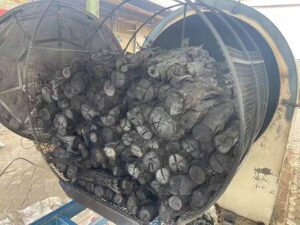
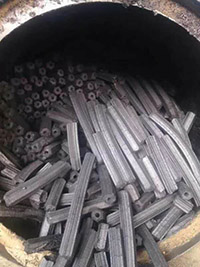
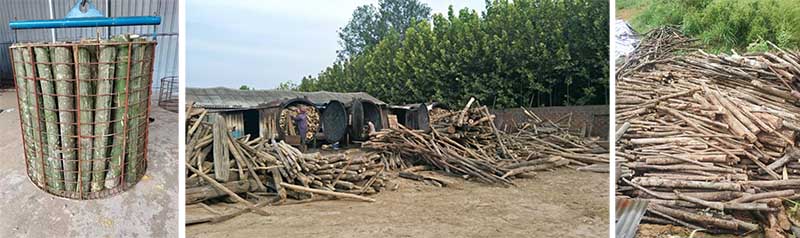
Traditional vertical kilns often have limitations in raw material loading, resulting in limited product types. In contrast, horizontal carbonization furnaces eliminate this issue with excellent versatility. They can effectively carbonize a wide range of biomass materials, including logs, sawdust briquettes (compressed charcoal sticks), animal bones, and biomass pellets, all while ensuring high-quality charcoal output.
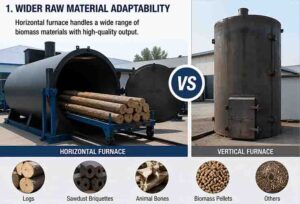
Difference between horizontal and vertical carbonization furnaces

2. Innovative Internal Structure & Superior Sealing

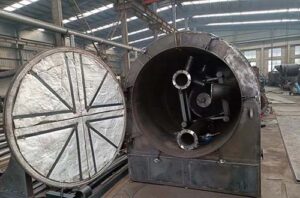
In terms of structural design, horizontal furnaces are more advanced than vertical ones. A horizontal carbonization furnace consists of a furnace body, furnace cover, heating chamber, and exhaust system. The key difference lies in its built-in independent inner chamber.

The edge of the inner chamber is designed with a downward-folded annular flange, which tightly fits with the sealing ring inside the furnace.

This innovative design not only makes loading and unloading (especially for long materials like logs or briquettes) more stable and convenient, but also provides excellent sealing performance, significantly improving operational safety and efficiency.
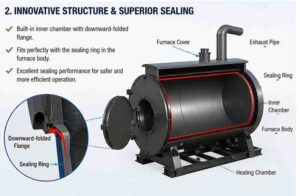
Difference between horizontal and vertical carbonization furnaces 1

3. Precise Pyrolysis Process Control

The horizontal carbonization furnace allows precise execution of the dry distillation process. It is easy to operate and ensures high production efficiency. The entire carbonization process is scientifically divided into five stages:

  • Drying & Initial Pyrolysis: Gradual heating from ambient temperature to 170°C–200°C, then up to 340°C. Low and steady heating ensures uniform temperature distribution.
  • Rapid Pyrolysis & Final Stage: When temperature reaches 380°C–400°C and smoke becomes lighter, heating is stopped. Avoiding excessive flames helps maximize fixed carbon retention.

Compared with vertical kilns, horizontal furnaces are more suitable for recovering by-products such as gas and oil, and are ideal for energy-saving and environmentally friendly production.
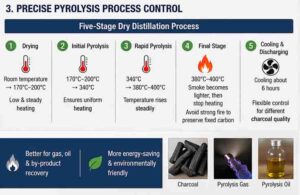
Difference between horizontal and vertical carbonization furnaces 3

4. Efficient Production Cycle & Controllable Output

Horizontal carbonization furnaces offer a clear and efficient production schedule:

  • Log charcoal: approx. 16 hours per batch
  • Briquette charcoal: approx. 15 hours per batch
  • Cooling time: around 6 hours

In the final cooling stage, horizontal furnaces provide flexible control:

  • High-gloss charcoal: Seal the exhaust outlet completely and allow natural cooling (down to about 40°C). The resulting charcoal has a smooth and glossy surface.
  • Standard charcoal (non-gloss): Open the exhaust outlet during cooling. The charcoal quality remains high, but without surface gloss.
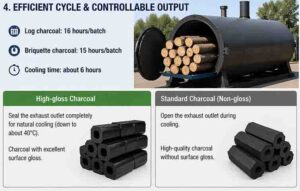
Difference between horizontal and vertical carbonization furnaces4

Conclusion

If you need to process diverse biomass materials—especially long-shaped logs or briquettes—and aim to produce high-quality charcoal with high fixed carbon content, the horizontal carbonization furnace is a more efficient and safer choice than traditional vertical kilns. Its convenient horizontal loading structure, superior sealing performance, and precise control of the pyrolysis process make it ideal for modern production demands.


Basic parameters and features>>

The equipment is covered by a 12-month warranty, excluding damage caused by human error and consumable parts.

Parameter PUTHL-1 PUTHL-2 PUTHL-3 PUTHL-4
Diameter (mm) 800 × 1000 1000 × 1200 1200 × 1200 1500 × 1000
Yield (kg/h) 300 600 800 1000
Liquefied Gas Burner 5 6 9 12
Carbonization Temperature (℃) 350 – 850 350 – 850 350 – 850 350 – 850
Fan 15 22 30 35
Main Burner 1 1 1 1
Main Unit Power (kW) 4 5.5 7.5 11.5
  1. Uniform Product Quality: The horizontal layout ensures materials stay in contact with heat sources for a consistent duration, avoiding uneven carbonization common in vertical models.
  2. Flexible Production Scales: It supports both batch and semi-continuous operation, adapting to raw material supply stability—ideal for small workshops and medium-sized factories alike.
  3. Low Energy Consumption: Double-layer insulation and waste heat recovery reduce external energy demand by 20–30% compared to traditional furnaces.
  4. Wide Material Compatibility: It processes almost all biomass wastes, including bamboo, wood chips, coconut shells, rice husks, bran, and crop straws.
  5. Easy Operation & Maintenance: The horizontal structure allows convenient access to internal components for cleaning and repair, with low technical thresholds for operators.

Application of horizontal carbonization furnace

Working principle of Horizontal Carbonization Furnace>>

  1. Pretreatment & Sealed Feeding The raw biomass materials, such as bamboo, wood chips, coconut shells, and rice husks, are crushed into smaller particles, such as 1 to 5 cm. Afterward, the crushed materials are dried to reach the moisture level of 8 to 12 percent. Finally, the crushed materials are fed into the sealed horizontal reaction chamber using the air-lock feeding system. This feeding system ensures that no external air enters the chamber, so the oxygen level remains at less than 5 percent, preventing combustion of the materials.
  2. Preheating & Drying (100–200℃) The horizontal chamber is divided into different temperature zones. At the first zone, materials are heated using waste heat available from subsequent stages of high-temperature processing. The bound water in the materials is completely vaporized, and the materials are preheated in preparation for pyrolysis. This process maximizes energy efficiency and saves on processing costs.
  3. Oxygen-Limited Pyrolysis (200–400℃) As the materials move towards the second temperature zone in the horizontal chamber, the temperature is raised to between 200-400℃ in the oxygen-deficient environment. Here, the hemicellulose, cellulose, and lignin in the biomass are thermally decomposed to give off volatile gases such as bio-gas, wood vinegar vapor, and tar vapor. The gases are either channeled back to the furnace as fuel for the combustion process or collected through the condensation system for further processing as by-products.
  4. High-Temperature Carbonization (450–650℃) This is the main stage in the process. At this point, the remaining solid materials move to the zone with a high temperature (450-650℃), where they undergo condensation and aromatization reactions. This means that the organic matter is broken down further and carbonized to a porous carbon structure. This horizontal arrangement ensures that the materials remain in contact with the heat source for a specified period. This explains the constant quality attributes of the produced charcoal, such as a constant carbon content of 70-80% and a constant ash content of 1.99-4.63%.
  5. Sealed Cooling & Discharging The hot charcoal is transferred into a sealed cooling compartment located at the end of the horizontal chamber. The temperature of the hot charcoal is between 400-500℃. The hot charcoal is cooled down to below 50℃ using water or air circulation. The process of cooling is done in a sealed environment in order to prevent the hot charcoal from coming into contact with air, as this would cause oxidation of the charcoal and lower its quality. Once this process is complete, the final product is removed and stored or sent for other processes such as grinding into biochar powder or activation into activated carbon.

Equipment work Video>>

    Pyrolysisuinit Horizontal Carbonization Furnace: FAQ>>

    The combustible gas produced during carbonization can be recycled as auxiliary fuel for the furnace, reducing external energy consumption.

    With proper maintenance, the main furnace structure typically lasts 5–8 years, while wear parts such as seals and burners require periodic replacement.

    The horizontal carbonization furnace adopts intermittent operation, which provides flexible operation and easy control for small-scale production.

    Common sources include coal, gas, electricity, or even pyrolysis gas produced by the furnace itself.

    The finished product typically contains 70%–80% fixed carbon with low ash content (1.99%–4.63%), suitable for fuel, biochar, or industrial applications.

    Most horizontal carbonization furnaces process 1–2 tons of biomass within 12 hours, depending on material type, moisture content, and operating temperature.

    For best carbonization results, the recommended moisture content is below 15%–20%. Higher moisture may increase energy consumption and extend processing time.

    The furnace can be heated by diesel, LPG, natural gas, or biomass pyrolysis gas, depending on configuration and site conditions.

    The horizontal design requires relatively small floor space and is suitable for workshops, farms, and small industrial sites.

    Scroll to Top