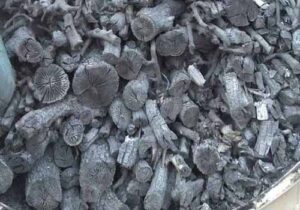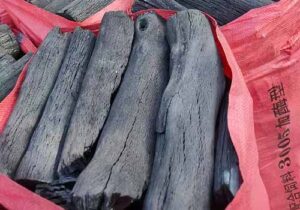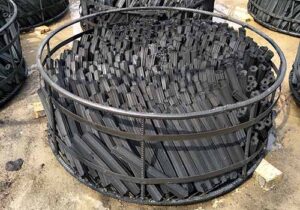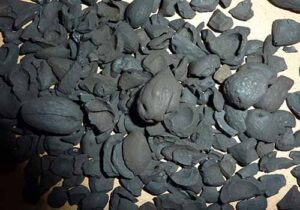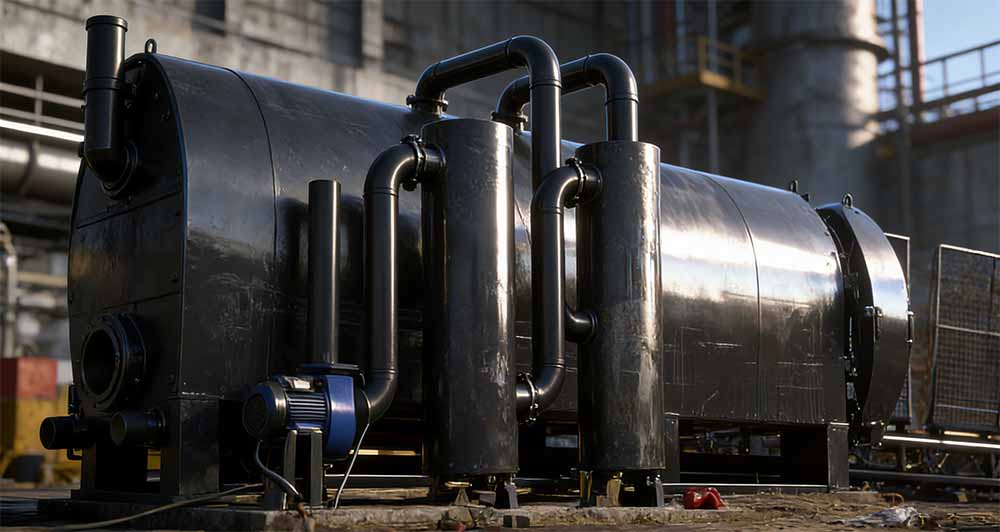

Convert biomass waste into high-value charcoal — with a daily capacity of 100 kg to 2 tons.
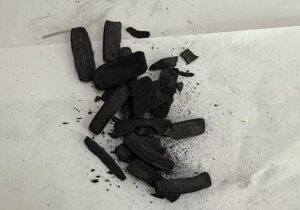
What is a Small Charcoal Making Machine?
A small charcoal making machine, also known as a small scale charcoal machine or small charcoal plant, is a compact, industrial-grade biomass charcoal machine designed for converting organic biomass materials into high-quality charcoal through oxygen-limited thermal decomposition (carbonization). Unlike large-scale industrial charcoal production equipment, it is optimized for low-volume, flexible operation while maintaining reliable carbonization efficiency.
It is specifically tailored for small-scale operators, including small businesses, startups entering the charcoal production industry, farms (for recycling agricultural waste into usable charcoal), and workshops. With a daily processing capacity of 100kg to 2 tons (24-hour operation), it features core advantages such as compact footprint, low initial investment, simplified operation (requiring only 1–2 operators per shift), and adaptable output—making it an ideal solution for users with limited space, budget, or small-volume production needs, bridging the gap between household-level and large industrial charcoal making.
It is specifically tailored for small-scale operators, including small businesses, startups entering the charcoal production industry, farms (for recycling agricultural waste into usable charcoal), and workshops. Its core advantages—compact footprint, low initial investment, simplified operation (requiring only 1–2 operators per shift), and adaptable output—make it an ideal solution for users with limited space, budget, or small-volume production needs, bridging the gap between household-level and large industrial charcoal making.


Raw Materials You Can Use
- Coconut shell: Ideal for coconut shell charcoal machine. The coconut shell charcoal produced has high density, hard texture, excellent combustion durability and high calorific value. It is widely used in barbecue (clean combustion, no smoke), water purification (strong adsorption capacity), and industrial metallurgy (high-temperature resistance). It is a high-value charcoal product.
- Rice husk: Suitable for rice husk charcoal machine. Rice husk charcoal is light in weight, has good adsorption and insulation properties. It is commonly used as a soil amendment (improving soil aeration and water retention), a filter material for wastewater treatment, and a raw material for activated carbon production. It is a cost-effective charcoal for agricultural and environmental applications.
- Sawdust: A classic raw material for sawdust charcoal machine. Sawdust charcoal has uniform particle size, stable combustion performance and moderate calorific value. It is widely used in daily life (household heating, cooking) and small-scale industrial production (product drying). It is easy to obtain raw materials and has high cost performance, making it the most commonly used raw material for small charcoal plants.
- Wood chips: Compatible with wood chip charcoal machine. Wood chip charcoal has similar properties to sawdust charcoal but with slightly higher density and calorific value. It is suitable for barbecue, industrial boiler fuel, and biomass power generation. It is especially suitable for small businesses near forestry areas where wood chip raw materials are abundant.
- Bamboo: Applicable to bamboo charcoal machine. Bamboo charcoal has a developed pore structure, strong adsorption capacity and good moisture absorption. It is mainly used for air purification (removing formaldehyde, odors), moisture-proof in homes and warehouses, and as a raw material for health care products (such as bamboo charcoal fiber). It has unique market positioning in the daily chemical and health fields.
- Palm kernel shell: Suitable for palm kernel shell charcoal machine. Palm kernel shell charcoal has high hardness, high calorific value and long burning time. It is widely used in barbecue, industrial heating and power generation. It is a high-quality raw material in regions rich in palm oil industry by-products, with stable supply and high economic benefits.
- Other materials: In addition, agricultural residues such as corn cobs, peanut shells, and straw, as well as forest waste such as branches and bark, can also be processed by biomass charcoal equipment. The charcoal produced is mostly used for agricultural and industrial fuel purposes, realizing the recycling of various low-value biomass wastes.
Which type of charcoal is better? It depends on the application scenario: For high-value scenarios such as water purification and high-end barbecue, coconut shell charcoal and bamboo charcoal are preferred due to their excellent adsorption and combustion performance; For daily heating, cooking and general industrial fuel, sawdust charcoal and wood chip charcoal are more cost-effective with easy access to raw materials; For agricultural improvement and environmental filtration, rice husk charcoal is the most suitable choice. In short, the “better” charcoal is the one that matches the user’s actual needs and raw material supply conditions.
How Does a Small Charcoal Making Machine Work?
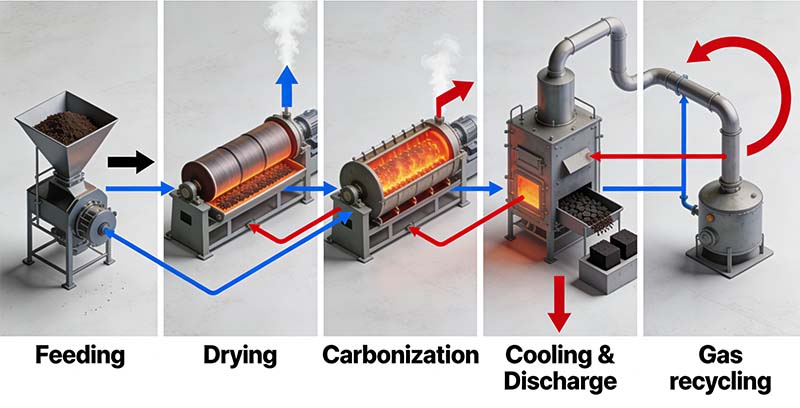
The small charcoal making machine adopts a streamlined, continuous charcoal production process centered on oxygen-limited pyrolysis and carbonization process. The entire operation is safe, efficient, and environmentally friendly, completed in 4 core steps with an additional gas recycling system to maximize resource utilization. The detailed working process is as follows:
- 1. Feeding: Pretreated raw materials (shredded biomass materials with moisture ≤15%, such as coconut shell, sawdust, or wood chips) are uniformly fed into the sealed feeding system of the machine. The sealed design ensures no air leakage during the subsequent carbonization process, which is the basis for stable pyrolysis.
- 2. Drying: The fed raw materials first enter the drying zone. Utilizing waste heat from the carbonization process, the materials are heated to 100–150℃ to remove residual moisture. Sufficient drying prevents incomplete carbonization, ensures uniform charcoal quality, and avoids excessive energy consumption in the subsequent stage.
- 3. Carbonization: This is the core link of the charcoal production process. The dried materials enter the sealed carbonization chamber, where they undergo pyrolysis (thermal decomposition) at 400–600℃ under oxygen-limited conditions. During this process, organic components in the biomass are decomposed into combustible gas, tar, and solid charcoal, realizing the transformation from raw material to primary charcoal.
- 4. Cooling & Discharge: The high-temperature charcoal generated after carbonization is sent to the cooling zone through a sealed conveying device. It is rapidly cooled to room temperature using air or water cooling (avoiding re-oxidation of hot charcoal). After cooling, the finished charcoal is discharged automatically, with uniform quality and stable performance.
Gas Recycling System: A key environmental and energy-saving design of the machine. The combustible gas (syngas) generated during the carbonization process is collected through a dedicated pipeline, purified to remove tar and impurities, and then reused as fuel to heat the drying zone and carbonization chamber. This closed-loop gas recycling not only eliminates environmental pollution caused by gas emission but also reduces reliance on external energy sources, significantly lowering the operating cost of the charcoal production process.
Models & Technical Specifications
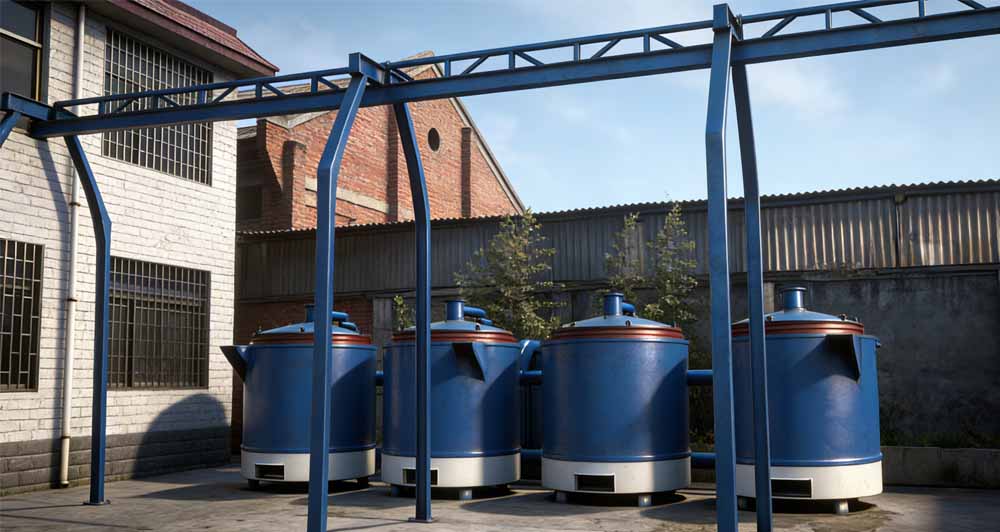
Small hoisting Charcoal Making Machine
The small hoisting type adopts a suspended sealing design, which ensures excellent airtightness, stable pyrolysis performance, compact footprint and simple operation.
Parameter
- Power:4-11.5KW
- Carbon extraction rate 80%-70%
- It can process 100-500kg of tires in 24 hours.
Small horizontal Charcoal Making Machine
Horizontal Carbonization Furnace is a biomass carbonization system installed in a horizontal configuration. It converts biomass materials into charcoal (or biochar) through high-temperature pyrolysis under oxygen-limited conditions.
Parameter
- Power:4-11.5KW
- Carbon extraction rate 80%-70%
- It can process 1-2 tons of tires in 24 hours.
The equipment is covered by a 12-month warranty, excluding damage caused by human error and consumable parts.
Carbonization Furnace Technical Parameters
| Parameter | PUTHL-1 | PUTHL-2 | PUTHL-3 | PUTHL-4 |
|---|---|---|---|---|
| Diameter (mm) | 800 × 1000 | 1000 × 1200 | 1200 × 1200 | 1500 × 1000 |
| Yield (kg/h) | 300 | 600 | 800 | 1000 |
| Liquefied Gas Burner | 5 | 6 | 9 | 12 |
| Carbonization Temperature (℃) | 350 – 850 | 350 – 850 | 350 – 850 | 350 – 850 |
| Fan | 15 | 22 | 30 | 35 |
| Main Burner | 1 | 1 | 1 | 1 |
| Main Unit Power (kW) | 4 | 5.5 | 7.5 | 11.5 |
Can I Make Money With a Small Charcoal Machine?
Yes, a small charcoal machine (also called small scale charcoal plant or biomass charcoal equipment) is a profitable investment, especially for small businesses, startups, farms, or workshops. Its profit potential comes from low raw material costs, stable charcoal market demand, and energy-saving operations. Below is a detailed analysis of key cost-profit factors and ROI (Return on Investment) to help you evaluate the commercial value clearly:
1. Core Cost Factors (Per Ton of Charcoal Production)
- Raw Material Cost: The main raw materials (coconut shell, rice husk, sawdust, wood chips, bamboo, palm kernel shell) are low-cost or even free agricultural/forestry wastes. Taking common sawdust as an example, the cost is about $30–$50 per ton; for straw or rice husk, it’s as low as $15–$30 per ton. Typically, 2.2–2.8 tons of raw materials can produce 1 ton of charcoal, so the raw material cost per ton of charcoal is only $66–$140.
- Electricity Cost: Most small charcoal machines (e.g., vertical carbonization furnace) have low power consumption, and some even don’t need additional electricity after preheating—relying on recycled combustible gas for heating. For full-set equipment (crusher + dryer + carbonization furnace), producing 1 ton of charcoal consumes about 300 kWh of electricity. Based on an average electricity price of $0.15 per kWh, the electricity cost per ton is about $45.
- Labor Cost: The equipment is easy to operate, requiring only 1–2 operators per shift. Taking a monthly salary of $300–$500 per person, the labor cost per ton of charcoal is about $30–$60 (calculated based on a daily output of 1 ton of charcoal).
Total production cost per ton of charcoal: Approximately $141–$240 (excluding minor costs like machine depreciation and packaging).
2. Charcoal Selling Price & Profit Margin
Charcoal has stable market demand in barbecue, agriculture (soil amendment), industry (heating), and water purification. The selling price varies by charcoal type and quality:
- Common sawdust/wood chip charcoal: $180–$250 per ton;
- High-value charcoal (coconut shell charcoal, bamboo charcoal): $300–$450 per ton due to better adsorption and combustion performance;
- Processed charcoal powder (for activated carbon raw material): $225–$300 per ton.
Profit per ton of charcoal: $40–$209 (calculated as selling price minus total production cost). For a small charcoal machine with a daily output of 1 ton (24-hour operation), the monthly profit can reach $1,200–$6,270.
3. ROI (Return on Investment) Calculation
The initial investment of a small charcoal machine ranges from $2,250 to $10,000, depending on capacity and configuration (e.g., small briquette making machine: $1,500–$2,800; full-set carbonization furnace: $4,000–$6,600). Based on different profit levels:
- Low-profit scenario (monthly profit $1,200): ROI period = Initial investment ($2,250) ÷ Monthly profit ($1,200) ≈ 1.88 months;
- Medium-profit scenario (monthly profit $3,000): ROI period = Initial investment ($6,000) ÷ Monthly profit ($3,000) = 2 months;
- Conservative estimate: Even with fluctuations in raw material prices and sales volume, the ROI period of a small charcoal machine is generally 3–12 months, which is a high-return investment in the waste-to-resource industry.
In summary, the small charcoal machine’s low cost, high profit margin, and short ROI period make it a viable money-making project. Its profitability is further enhanced by the wide availability of raw materials and stable charcoal demand—especially suitable for small-scale investors looking for low-risk, quick-return industrial projects.
Why Choose Our Small Charcoal Making Machine?
Choosing a reliable supplier is key to profitable operation of your small charcoal making machine (small scale charcoal plant / biomass charcoal equipment). We stand out with full-lifecycle professional support, core advantages as follows:
1. Professional Factory & Quality Assurance
Direct manufacturer with strict quality control; ISO 9001 compliant. No middlemen, ensuring cost-effective, high-reliability equipment directly from the source.
2. Shipping, Installation & Training
Shipping terms: Optional FOB, DDP or CIF. Installation service: Customized on-site installation and debugging by professional engineers, plus operator training. Installation fee: 200 USD per day, with accommodation, meals, and round-trip air tickets provided by the customer. This ensures you start production quickly with clear cost expectations.
3. 24/7 Comprehensive After-Sales
24/7 technical support via multiple channels; on-site maintenance for complex issues. Regular follow-ups to optimize operation.
4. Original Spare Parts & Fast Delivery
Sufficient original spare parts in stock; global fast delivery, minimizing production downtime.
5. Reliable Warranty
12–24 month warranty (model-dependent); free repair and part replacement for non-human quality issues, reducing investment risks.
We’re committed to supporting small investors (businesses, startups, farms) with stable equipment and efficient service. Choose us for long-term profitability.
FAQ about Small Charcoal Making Machine
What raw materials can be used?
A Small Charcoal Making Machine can process a wide range of biomass materials, including:
- Coconut shells
- Rice husks
- Sawdust
- Wood chips
- Bamboo
- Palm kernel shells
- Peanut shells
- Corn cobs
- Straw and other agricultural residues
These materials are carbonized through a controlled pyrolysis process to produce high-quality charcoal suitable for fuel, BBQ, industrial use, or briquette production.
What is the charcoal yield?
Charcoal yield is typically 70–80% by weight after moisture and volatile components are removed.
That means:
1,000 kg of dry biomass → 700–800 kg of solid carbonized material
The remaining 20–30% is released as combustible gas and vapor during carbonization, which is reused as fuel in the system
In practical operation:
If you feed 1 ton of properly dried coconut shell, bamboo, or wood,
you will get about 700–800 kg of finished charcoal.
The exact yield depends on:
Moisture content of the raw material
Carbonization temperature
Process control inside the reactor
A small charcoal making machine achieves the same yield rate as large continuous plants — the difference is only daily processing capacity, not conversion efficiency.
Is it continuous or batch?
Power consumption is very low.
The installed motor power of a small charcoal making machine is only 4–11.5 kW, which is mainly used for:
Feeding system
Discharge system
Cooling fan
Control system
The carbonization itself does not rely on electricity — it is heated by the combustible gas released from the biomass during pyrolysis. After start-up, the machine runs almost energy self-sufficient.
So in real operation, electricity cost is minimal compared with the value of the charcoal produced.
How long does one batch take?
One batch takes about 6 hours.
The machine is designed for 24-hour continuous operation, with each carbonization cycle (one batch) taking around 6 hours from feeding to finished charcoal discharge.
This means you can run 3–4 batches per day, allowing stable and efficient charcoal production while maintaining high carbonization quality.
Is it environmentally friendly?
Yes, it is environmentally friendly
A small charcoal making machine uses gas recycling and controlled pyrolysis, so:
Smoke and harmful gases are largely burned or filtered before discharge
No open burning of biomass, greatly reducing air pollution
Residual gases can be reused as fuel for heating, saving energy
Produces clean, high-quality charcoal with minimal environmental impact
In short, it meets modern emission standards and is suitable for sustainable charcoal production.
What size should I start with?
It depends on your raw material availability, daily production needs, and budget.
For beginners or small businesses:
500 kg – 2 tons per day capacity is ideal.
This size allows you to learn the process, control quality, and test the market without a huge investment.
Machines in this range are easy to operate, install, and maintain, while still producing profitable amounts of charcoal.
Once your business grows, you can upgrade to larger or continuous machines to increase daily output.