Pyrolysis Market In Thailand
Based on a fresh search snapshot and current public sources, the Thailand pyrolysis market is being shaped by three big forces: a large plastics and rubber waste stream, tighter waste rules, and growing demand for recycled outputs like pyrolysis oil and recovered carbon black.
Thailand’s plastics sector is large, but its recycling system still leaves a lot of value on the table. At the same time, end-of-life tire projects are moving from small local operations into bigger industrial supply chains.
The semantic keyword map behind the first-page results
I cannot pull a literal live Google homepage inside this chat, so I used a fresh web search snapshot and related authoritative sources to map the recurring search themes. The same words show up again and again because they match what buyers, investors, and regulators care about in Thailand.
Core semantic node | Repeated keywords you keep seeing | Why it matters in Thailand |
Thailand market | Thailand, Southeast Asia, Bangkok, Ayutthaya | Searchers want local proof, not just general pyrolysis theory. |
Waste tires | ELT, end-of-life tire, tire recycling, used tire | Thailand has a real tire waste stream and active recycling projects. |
Plastic waste | plastic waste, plastic scrap, municipal plastic | Plastic waste is a major policy and market driver. |
Pyrolysis oil | pyrolysis oil, fuel oil, industrial fuel | Oil sales are a key revenue line for plastic and tire pyrolysis. |
Recovered carbon black | rCB, recovered carbon black, carbon black | Tire projects increasingly need a higher-value solid product, not only oil. |
Circular economy | circular economy, BCG, recycling loop | Thailand’s policy language pushes projects toward circular use, not simple disposal. |
Regulation | import ban, waste control, permit, compliance | Rules around imports and waste handling now shape project economics. |
Feedstock supply | collection, sorting, contamination, local supply | A plant only works if the waste stream is steady and clean enough. |
Emissions control | emissions, pollution, incineration, environmental impact | Public pressure is high, so air control and process control matter. |
Investment signal | project, capacity, certification, partner | The market is moving from talk to actual capital and certified plants. |
If I turn that map into simple SEO language, the strongest semantic cluster for Thailand is not just “pyrolysis.” It is “Thailand plastic waste management,” “waste tire pyrolysis,” “pyrolysis oil,” “recovered carbon black,” “circular economy,” and “import ban / compliance.” That is the language the market is using right now.
Why Thailand is a real market, not a fake one
Thailand’s plastics economy is not small. The World Bank says Thailand’s petrochemical sector was the largest in Southeast Asia and the 16th largest in the world, and it produced 11.8 million tonnes of downstream products in 2018. The same report says the plastics industry contributed US$36.9 billion, or 6.71% of GDP. That is a strong base for recycling and chemical recycling projects.
But the waste side is the problem. The World Bank also found that even with an 88.8% municipal solid waste collection and recycling rate, Thailand still had about 428 kton/year of mismanaged plastic waste. In its higher-priority catchments, 9.3 kton/year was estimated to reach the marine environment, and rural areas were a major source of exposed mismanaged waste.
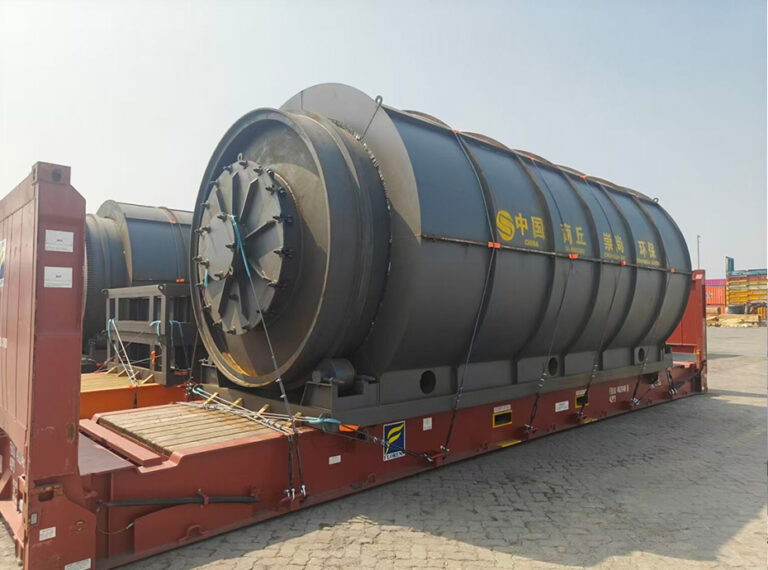
That gap between “lots of plastic use” and “not enough recovery” is exactly why pyrolysis gets attention. It is one of the few options that can turn dirty plastic streams into a saleable oil product, especially when the feedstock is hard to recycle mechanically. USTDA’s Thailand project with VAO Energy says this directly: the plant would use pyrolysis to process plastic waste into pyrolysis oil, cut emissions, and fit Southeast Asia’s recycling needs.
The tire side is also real. A 2014 material flow study found that Thailand’s used tire management was still weak at that time, with 48.9% going through destructive technologies, 44.4% dumped in the open environment, and only 6.7% handled through material recovery. That is old data, but it explains why tire pyrolysis found room to grow later.
The policy wall is now shaping the market
Thailand’s plastic waste roadmap, tracked by the IEA, sets two clear targets: reduce and replace single-use plastic, and reach a 100% circular economy by 2027. The roadmap also shows staged restrictions on caps, oxo-degradable plastics, microbeads, foam food containers, straws, and certain bags and cups. The BOI is also described as offering favorable incentives for companies that use secondary raw materials, run recycling businesses, or improve environmental performance.
The biggest policy shift for many project models is the ban on plastic waste imports. Public reporting says Thailand announced a ban that took effect on January 1, 2025, with the earlier 2023–2024 period tightly regulated and limited to 14 recycling plants in a tax-free zone. That means the market is moving away from import-led feedstock and toward domestic collection, sorting, and recovery.
That matters a lot for you if you sell equipment. A project that once depended on imported scrap now has to prove local supply, cleaner sorting, and stronger process control. In plain terms, the machine is only part of the business; the waste supply chain is now just as important.
Thailand’s wider policy tone also supports this direction. USTDA said the VAO project fits the country’s Bio-Circular-Green model, which aims to use technology and innovation to move the economy toward value-based growth. That gives pyrolysis a policy story, but only if the project is clean, traceable, and useful to domestic industry.
Where the strongest money is likely to be made
For Thailand, the most practical pyrolysis business lines are waste tires and plastic waste. Tire projects can sell pyrolysis oil, steel, and recovered carbon black. Plastic projects usually focus on pyrolysis oil as a refinery or industrial feedstock substitute. Those are the outputs that investors and industrial buyers care about.
The strongest market signal is that large groups are already investing. Marubeni said in 2024 that it entered the ELT pyrolysis recycling business in Thailand through Green Rubber Energy in Samut Prakan, a company with a processing power of 10,000 tons of ELT per year. In 2025, Hanwa said it invested in Pyro Energie in Thailand, which has a 100 kilotonne-per-annum capacity and held ISCC+ certification in 2023. Those are not toy projects. They show real industrial interest.
There is also a clear product-quality trend. The Hanwa deal was tied to higher-value outputs like pyrolysis oil and recovered carbon black, not just disposal. That means the market is no longer satisfied with “we processed waste.” It wants certified, traceable, saleable material.
A simple way to see the business fit is this:
Feedstock | Main value products | Best fit in Thailand | Main risk |
Waste tires | pyrolysis oil, rCB, steel | Strong, because tire projects already have real industrial buyers | Feedstock consistency and ash/impurity control |
Mixed plastics | pyrolysis oil | Strong when sorted well and tied to domestic waste supply | contamination and unstable oil quality |
Industrial rubber/plastic scrap | oil and solid residues | Good for localized projects with stable contracts | small volume, contract risk |
That table is not theory. It matches the way current Thai projects and policy are moving: toward cleaner feedstock, stronger offtake, and higher-value outputs.
What I would check before building a project in Thailand
When I look at a pyrolysis project in Thailand, I start with six checks. First is feedstock. Second is product offtake. Third is emissions control. Fourth is local permits. Fifth is product certification. Sixth is cash flow timing. If one of these is weak, the project can still look good on paper and fail in real life.
Here is a practical project parameter list:
Parameter | What you should define early | Why it matters in Thailand |
Feedstock source | tires, plastic scrap, industrial waste, local collection radius | The import window is closing, so domestic supply matters more. |
Capacity | tons/day or tons/year | Real projects in Thailand now range from 10,000 t/y to 100 ktpa in public announcements. |
Product mix | oil, gas, char, steel, rCB | Revenue depends on what the plant can sell, not only what it can process. |
Quality standard | sulfur, ash, moisture, traceability | Buyers want cleaner, more stable output and certification. |
Compliance | waste handling, air control, import rules | Thailand is tightening waste and plastic rules. |
Business model | fee-based disposal, product sale, or both | Mixed income streams reduce risk when oil prices move. |
For an equipment buyer, this is the key point: the best machine is the one that fits the local waste stream. A system designed for clean, stable tire chips is not the same as one built for dirty mixed plastic. In Thailand, feedstock reality matters more than brochure claims.
Outlook: what happens next in Thailand
The Thailand pyrolysis market looks promising, but it will reward disciplined projects, not fast promises. The policy direction is clear: less imported plastic waste, more domestic recovery, more circular economy language, and more pressure on waste handlers to prove that they are actually reducing pollution.
The strongest near-term winners will be projects that do three things well. They secure local feedstock. They sell a product that industry can actually use. And they keep emissions, contamination, and traceability under control. That is why tire pyrolysis with rCB, and plastic pyrolysis with stable oil offtake, stand out.
If I sum it up in one sentence, Thailand is not a market where you sell a reactor and walk away. It is a market where you help build a full system: collection, sorting, processing, product quality, and compliance. That is the real opportunity.
Historical timeline
Year | Milestone | Why it matters |
2012 | Used tire study found heavy dumping and destructive disposal | Shows the early weakness in tire recovery. |
2018 | Thailand launched the plastic waste management roadmap | Set the circular economy direction. |
2021 | World Bank published Thailand plastics circularity study | Quantified market value and recycling gaps. |
2022 | USTDA funded VAO’s plastic pyrolysis feasibility study | Showed foreign support for pyrolysis-based recycling. |
2023 | Thailand announced a ban on plastic waste imports by 2025 | Marked the shift toward domestic feedstock. |
2024 | Marubeni entered the Thai ELT pyrolysis business | Confirmed strong corporate interest in tire pyrolysis. |
2025 | Hanwa invested in Pyro Energie in Thailand | Showed the market had moved into larger, certified projects. |
2025 | Plastic waste import ban took effect | Tightened the market around local supply chains. |
Q&A
Q1: Is Thailand a good market for pyrolysis equipment?
Yes, but only for projects with real feedstock, real buyers, and strong compliance. Thailand has waste pressure, policy support for circular economy projects, and several active tire and plastic pyrolysis cases.
Q2: Which is stronger in Thailand, tire pyrolysis or plastic pyrolysis?
Tire pyrolysis looks more mature right now because there are clear industrial signals, including ELT projects and rCB interest. Plastic pyrolysis is also promising, but it depends more on sorting quality and stable domestic feedstock.
Q3: Why does the 2025 plastic waste import ban matter so much?
It changes the whole business model. Projects can no longer rely on imported plastic waste the way some did before, so domestic collection and sorting become much more important.
Q4: What products can a Thai pyrolysis plant sell?
The main outputs are pyrolysis oil, gas, char, steel from tires, and recovered carbon black in better tire projects. The best product mix depends on feedstock and buyer demand.
Q5: What is the biggest risk in Thailand?
The biggest risk is weak feedstock control. If the waste is too dirty, too mixed, or too unstable in supply, the plant will struggle with product quality and cash flow.
Q6: What should I check before choosing equipment for Thailand?
Check the waste type, the daily supply volume, the emissions system, the product specification, the permit path, and the buyer for the end product. In Thailand, the project has to work as a full system, not just as a machine.