

Transforming Waste into Energy and Value
India faces a mounting waste challenge, especially from non-biodegradable plastics and old tires. Pyrolysis technology – thermal decomposition of waste in oxygen-free conditions – offers a sustainable solution. By converting mixed plastic waste, end-of-life tires and rubber into valuable products like pyrolysis oil, carbon black, and steel wire, pyrolysis plants drastically reduce landfill and pollution.
A pyrolysis plant uses high heat to crack long-chain polymers; the resulting pyrolysis oil (liquid fuel), syngas (flue gases) and solid char can all be repurposed. This makes pyrolysis an efficient waste-to-energy process: for example, roughly 40–60% of plastic feedstock becomes liquid fuel oil, 20–30% gas, and 10–20% carbon char. By integrating condensers and scrubbers, modern pyrolysis systems capture this oil and clean the off-gases to meet pollution norms, ensuring an environmentally friendly operation.
Pyrolysis plants are gaining momentum in India due to supportive policies. The Ministry of Environment’s Plastic Waste Management Rules (2016, amended 2021) enforce Extended Producer Responsibility (EPR) and encourage recycling and reuse, while bans on single-use plastics push industries to find alternatives. Likewise, the Ministry of Science & Technology and CSIR have backed pyrolysis initiatives – for instance, DST’s Technology Development Board partnered with industry to commercialize purified pyrolysis oil for circular plastics. These efforts underscore India’s commitment to a circular economy.
Key Benefits: Pyrolysis plants achieve complete recycling of materials – for example, “100% recycling of waste tires; no material is left behind”. Waste rubber is shredded and heated in a reactor (often a rotating kiln) to yield gases and solid char. The gases are condensed into oil, and the remaining carbon-rich char (or recovered carbon black) can be used in manufacturing.
This zero-waste outcome not only diverts waste from landfills, it also produces revenue: pyrolysis oil serves as a fuel or feedstock, and carbon char has market value (though it may require purification). Compared to incineration, pyrolysis emits far fewer pollutants – operating in an oxygen-starved environment greatly reduces dioxins and furans. Moreover, pyrolysis generates energy that can power the plant itself or be sold as electricity, adding to its economic appeal.
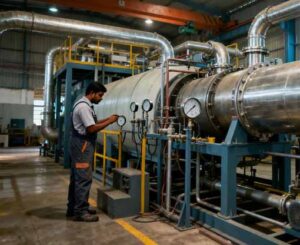
A pyrolysis plant typically includes a pre-treatment stage (shredding/sorting), a heated reactor, condensers and scrubbers, and storage tanks. Under controlled heat (300–900 °C) and no oxygen, the waste feedstock thermally cracks into smaller molecules. As shown below, modern systems often have automated feeders and airlocks to continuously load plastic or tire chips into the reactor, and to remove char, without lowering temperature. The hot vapors rise into condensers, where they cool into liquid pyrolysis oil, while non-condensable gases may be burned as fuel or flared. Solid carbon black and metal wires (from tires) are removed as residue. This process can be tuned – for example, slower heating yields more char, while higher temperatures increase gas fraction.
Figure: An automated pyrolysis reactor in a continuous waste-to-fuel plant (with airlock feed system and carbon discharge). Modern pyrolysis units often run at near-atmospheric pressure with safety interlocks and heat-recovery, as described by manufacturers like APChemi.
By design, pyrolysis plants maximize energy recovery and minimize emissions. Many plants reuse the produced syngas to heat the reactor, cutting external fuel needs. For instance, Aswathi Industries explains that “non-condensable gases are partially used as fuel to heat the kiln”, with exhaust cleaned by scrubbers to meet pollution control standards. Advanced designs include multi-stage condensers and waste-heat recovery systems. The result is a compact, low-emission facility: one wastes nothing and leaves only carbon-lean byproducts. Indeed, compared to combustion, pyrolysis avoids open burning of plastics and tires, reducing toxic smoke.
Plastic vs. Tire Pyrolysis Plants
India hosts specialized pyrolysis plants for different waste streams. Plastic pyrolysis plants handle mixed plastics (e.g. PE, PP, PS) that are hard to recycle by conventional means. In such plants, sorted plastic is fed into the reactor; under heat, it breaks down into plastic pyrolysis oil, gas and char. Tire pyrolysis plants, on the other hand, process shredded rubber from end-of-life tires. A typical tire pyrolysis system will first remove steel belts (the steel is recycled separately), then feed rubber crumb into the reactor. Tire pyrolysis yields tire pyrolysis oil, carbon black (recoverable char), steel wires, and gas.
Plastic Pyrolysis Oil – lighter hydrocarbons from polyolefins and polystyrenes.
Tire Pyrolysis Oil (TPO) – heavier, aromatic-rich oil from rubber polymers.
Both oils are combustible fuels, but their properties differ slightly. Wasteplasticpyrolysisplant.com notes that “plastic pyrolysis oil is heavy oil, normally of higher quality than tire oil or crude oil”. In practice, plastic pyrolysis oil tends to have fewer impurities and a higher calorific value, making it readily usable in industrial boilers and furnaces. Tire pyrolysis oil, rich in aromatics, has a high energy density (≈43 MJ/kg) and can similarly fuel boilers or generators.
The primary products of a pyrolysis plant – oil, gas and char – each find valuable applications.
Pyrolysis Oil: Often called fuel oil or pyrolysis diesel, this liquid is the bulk product (typically 30–45% yield for tires, up to 50–60% for plastics). It has a high heating value (about 41–43 MJ/kg) and can directly replace heavy fuel oil in industrial burners. Common uses include heating furnaces and boilers in cement, steel, glass and brick factories. Thanks to its high calorific value, pyrolysis oil can also run heavy fuel generators to produce electricity.
For example, one industry source explains that tire pyrolysis oil “can be directly used as fuel oil… in cement plants, steel plants, glass plants”. If refined (via distillation), this oil can even be upgraded to diesel fuel for vehicles, tractors and power generators. In fact, after careful distillation and desulphurization, tire or plastic pyrolysis oil can yield about 85% diesel by volume. Beyond fuels, distilled pyrolysis fractions can serve as chemical feedstocks: lighter fractions (naphtha) yield valuable aromatic compounds like benzene, toluene, limonene and xylene, which are precursors for plastics, solvents and resins.
Syngas (Pyrolysis Gas): This combustible gas mixture is often recycled on-site. After oil condensation, remaining gases (mainly methane, hydrogen, CO) burn cleanly to sustain the reactor’s heat or generate electricity. Thus, a pyrolysis plant can be energy self-sufficient, using its own off-gas to fuel the heaters. Any excess gas is flared after cleaning or scrubbed and released, minimizing emissions.
Carbon Char/Recovered Carbon Black (RCB): The solid residue (10–30% of output) is rich in carbon. In tire pyrolysis, this is called recovered carbon black – a mix of carbon, ash, zinc, sulfur and inert fillers. It can substitute for traditional carbon black in ink, rubber or construction (e.g. as filler) applications, though its quality depends on further processing. Char from plastic pyrolysis (often termed biochar if biomass used) can be used as solid fuel or soil amendment. For instance, APChemi notes that modern plants can even handle biomass pyrolysis to produce biochar, which sequesters carbon and can improve soils.
- Pyrolysis Oil Uses (Summary): In short, pyrolysis oil and char help industries replace fossil fuels and raw materials. They can:
- Fuel boilers, furnaces and kilns in heavy industries (steel, cement, brick, power plants).
- Generate electricity by running diesel generators or turbines, especially in regions lacking grid power.
- Produce on-site diesel after oil refining, to run vehicle fleets or machinery.
- Feed chemical and carbon markets: The char can be used in asphalt or ink, and distilled oil fractions can yield high-value aromatics for plastics and solvents.
All told, pyrolysis oil uses are diverse. It is essentially a secondary crude oil. A well-operated plant turns a waste stream into a reliable, carbon-neutral fuel that reduces dependence on imported petroleum.
Pyrolysis offers multiple strategic advantages for India’s economy and environment:
- Efficient Waste Management: Pyrolysis plants convert otherwise non-recyclable plastic and scrap tires into useful products. As Advance Biofuel highlights, these systems “provide an efficient solution for managing waste by converting it into useful products such as fuel oil, carbon black, and steel wire”. This 100% recycling (no residual waste) greatly reduces landfill needs and open burning.
- Environmental Benefits: Operating without open flames, pyrolysis emits far fewer harmful gases than incinerators. In fact, pyrolysis is noted to “produce fewer harmful emissions” compared to traditional burning of waste. The ability to capture and reuse gases internally also reduces net CO₂ emissions. By converting discarded plastics into fuel, pyrolysis helps cut methane from landfills and discourages ocean dumping. Moreover, it aligns with India’s climate goals: for example, biochars from pyrolysis can sequester carbon long-term.
- Energy and Resource Recovery: Every unit of waste converted yields energy. Pyrolysis plants can supply heat and power back to the grid or local industries. Additionally, India can cut crude oil imports by substituting pyrolysis-derived diesel. The Parliament release notes the government’s aim to reduce petroleum dependence through such measures.
- Economic Value and Revenue: Pyrolysis turns a disposal cost into profit. Selling pyrolysis oil and carbon char generates revenue. It also creates jobs: from plant operators and engineers to waste collectors. Local economies benefit from hosting such plants. Moreover, government incentives (e.g. subsidies for waste-to-fuel projects, inclusion under renewable schemes) can improve returns. Advance Biofuel points out that government support often exists for biofuel and recycling ventures.
- Regulatory Compliance and Circular Economy: Pyrolysis aligns with India’s regulations and circular economy vision. By meeting EPR targets, businesses can enhance their sustainability credentials. Pyrolysis oil can even be labeled “biofuels” (especially if derived partly from bio-based polymers), qualifying for renewable mandates. The Parliament release emphasizes that such initiatives help build a “self-reliant circular economy” and generate employment.
- Figure: Pyrolysis reactors can incorporate anti-coking technology to prevent carbon buildup. Leading manufacturers (e.g. APChemi) design reactors with advanced materials and cooling systems, ensuring high throughput and durability.
Beyond policy, practical engineering choices boost advantage. For instance, APChemi reports that anti-coking linings inside reactors improve capacity and extend life. Automatic feeding and temperature controls ensure consistent quality and operator safety. All this means modern pyrolysis plants are robust and efficient – ideal for India’s industrial sectors.
Operating pyrolysis plants in India requires meeting environmental norms. For instance, Central Pollution Control Board (CPCB) guidelines mandate that pyrolysis oil and char must be stored separately, and emissions must be controlled. In practice, plants include multi-stage scrubbers and precipitators. As noted by Aswathi Industries, pyrolysis facilities “vent exhaust gases through a scrubber and stack to meet the PCB Standards/norms”. Regular monitoring of flue gas, oil quality and residue is enforced to prevent pollution.
These measures ensure that pyrolysis is far cleaner than open dumping or incineration. Indeed, pyrolysis aligns with India’s stringent waste and air rules. By converting plastic waste under controlled conditions, pyrolysis helps avoid the hazardous emissions that illegal burning or landfilling would cause. The technology also supports circular waste regulations: recovered carbon and oil feed back into industrial supply chains, reducing virgin material demand. In essence, pyrolysis plants are designed to complement India’s waste-management framework and environmental goals.